











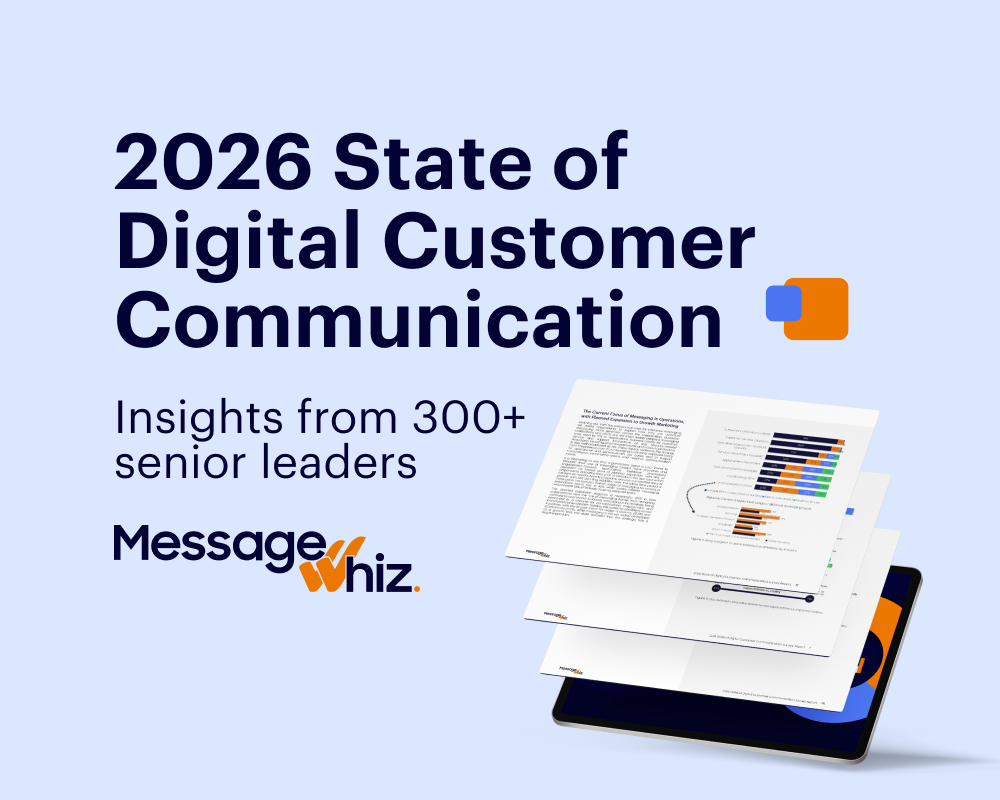





Most messaging stacks aren’t ready for AI workflows, and the gap isn’t where most teams are looking. According to the 2026 State of Digital Customer Communication Survey, 88% of respondents describe their messaging platform as only partially integrated with the systems where customer behavior actually lives. AI capability isn’t the ceiling. Integration depth is. This piece names the five layers that determine whether your stack is workflow-ready, and what each gap actually costs.
Businesses across all industries are investing more and more in AI with the expectation that smarter automation will transform the efficiency of customer communication. Some of those investments will pay off, but others will run into the same infrastructure-based ceiling. AI can only be effective when it has access to accurate customer data and the necessary communication systems.
In other words, no matter how good your AI tools are, they may lack the integration required to deliver on the promise of modern customer communication and CX.
What Are AI-Powered Messaging Workflows?
An AI-powered messaging workflow is a connected sequence of automated communication steps that triggers, adapts, and routes based on real customer behavior rather than a fixed schedule. Instead of sending the same message to a defined list at a predetermined time, an AI-powered workflow detects a behavioral signal and responds to it on the right channel, at the right moment, without manual intervention at each step. Your CRM, AI agents, or other management systems supply the behavioral intelligence. The messaging platform executes the response.
Standard automation pushes the same message to a list. An AI-powered workflow reacts to a signal, including the signal of absence, like a customer who has stopped doing something they used to do.
Why Does Infrastructure Determine Whether AI Messaging Actually Works?
When messaging systems and business systems don’t share data in real time, AI workflows can only act on what they can see, and what they can see is almost always incomplete. The result isn’t just missed opportunities. In some cases, it’s actively damaging to the customer relationship.
Consider a loyalty program member who hasn’t logged in for two weeks. Your system knows about that behavioral change because it stopped issuing one-time passwords for account access. However, that OTP pattern is a signal most messaging platforms would never catch because they’re not integrated deeply enough to read the absence of behavior, only the presence of it. A workflow-ready stack reads both, and can send a re-engagement message based on that specific signal rather than a generic inactivity timer that fires on a schedule regardless of what actually happened.
Or consider a customer who contacts your support team about a billing issue on a Tuesday morning, while a promotional campaign is already queued to go out to them that afternoon. Without integration between your customer service platform and your messaging layer, that promotion goes out on schedule, and the customer receives a cheerful offer for the very service they’re currently frustrated with. They don’t think “the automation misfired.” They think the company has no idea what’s going on.
A third scenario I have seen while working with clients is where connected infrastructure stops being a defensive necessity and becomes a genuine competitive advantage. A hotel receives a data signal that a guest’s inbound flight has been delayed by four hours. Because their property management system is integrated with their messaging platform, the hotel can automatically arrange lounge access at the departure airport and send the guest a WhatsApp message with the details before the guest has even had time to feel frustrated about the delay. That interaction doesn’t happen because the hotel has better AI. It happens because their systems are connected well enough for the AI to act on information the moment it becomes available.
The 2026 State of Digital Customer Communication Survey found that 70% of companies consider smart routing and timing their most valuable AI feature. What that finding really reflects is that companies understand, intuitively, that relevance is a timing problem as much as a content problem. The infrastructure question is whether your stack can actually deliver on that timing when it counts.
What Does a Broken Messaging Infrastructure Actually Cost You?
The most visible cost is the missed moment: the re-engagement message that fires a day too late, the offer that goes to a customer who shouldn’t receive it, the follow-up that repeats context the customer already provided to a different channel. Each of those failures is recoverable on its own. The pattern of them is harder to recover from, because customers don’t file complaints about inconsistent automation. They simply stop engaging and you never find out why. The Salesforce State of Service report found that 61% of service professionals believe their organization handles issues proactively, but only 33% of customers agree, according to the same research. That gap doesn’t come from bad intentions. It comes from systems that don’t talk to each other.
The less visible cost is the measurement problem. When your workflows aren’t integrated with your business systems, you can track delivery rates and open rates, but you can’t connect messaging activity to actual business outcomes. You can see that a message arrived. You can’t see whether it drove a conversion, prevented a churn, or moved someone through a journey. Without that connection, you’re optimizing for proxies rather than results, and the gap between what your metrics say and what your business is actually experiencing grows wider over time.
Sixty-two percent of companies in the 2026 survey named easy integration with existing systems as a top-three requirement when evaluating a new messaging channel. The companies that treat integration as a prerequisite rather than a follow-up task are the ones whose AI-powered workflows perform the way the roadmap promised.
What Does a Workflow-Ready Stack Look Like in Practice?
A workflow-ready messaging stack has one defining characteristic: every system that holds a behavioral signal is connected to your messaging layer in real time, and your messaging layer knows what to do when that signal changes. That connectivity operates across five layers. Each one determines a different dimension of whether your AI-powered messaging workflows can perform the way they’re supposed to.
Layer 1: Real-Time Data Connectivity
Your messaging platform can only act on what it can see. When the systems that hold customer behavior share data with your messaging layer on a delay or not at all, every workflow downstream is working with an incomplete picture. Real-time connectivity means the signal reaches your messaging platform the moment it’s generated, not the next morning during a batch sync.
Layer 2: Absence-Aware Behavioral Triggers
Most platforms can trigger on what a customer does. Fewer can trigger on what a customer has stopped doing. The loyalty member who hasn’t logged in for two weeks hasn’t generated a new event, their signal is an absence of one. A workflow-ready stack can read that gap and act on it, so your re-engagement campaigns respond to actual behavioral change rather than a generic inactivity timer that fires on schedule regardless of what happened.
Layer 3: Cross-System Suppression
Knowing when to send a message matters. Knowing when not to is just as important. If your messaging layer has no visibility into your support or service systems, outbound campaigns go out on schedule even when a customer is in the middle of a billing dispute or an unresolved complaint. Suppression logic requires your messaging platform to query your service and ticketing systems before any campaign sends, so customers in active issues are held back automatically.
Layer 4: Event-Driven Execution
Some of the highest-value messaging moments come from external events your team didn’t create and can’t predict. A flight delay. A package status change. A booking modification. Whether your messaging platform can act on those events in the moment depends on whether your operational systems are configured to push data to your messaging layer when a status changes. The window for a useful message is often minutes, not hours.
Layer 5: Outcome-Level Measurement
A workflow-ready stack doesn’t just send messages. It connects them to results. Delivery rates and open rates tell you whether a message arrived. They don’t tell you whether it prevented a churn, drove a reactivation, or moved a customer through a journey. Closing that measurement gap requires your messaging platform to be integrated with the systems where downstream outcomes live, so you can trace a send back to a business result rather than optimizing for proxies that don’t reflect what’s actually happening.
None of these layers require new AI. They require your existing systems to share data reliably, in real time, with a messaging platform that knows what to do with it. And as always, AI should have some human oversight to ensure it is running as intended.
If you’re not sure where your stack stands, speak to an MMDSmart MessageWhiz expert.
FAQ
What is an AI-powered messaging workflow?
An AI-powered messaging workflow is an automated communication sequence that triggers based on real customer behavior, such as a change in activity, a service interaction, or a real-world event, and delivers the right message on the most effective channel without manual intervention at each step.
Why do most companies struggle to implement AI-powered messaging workflows?
The most common barrier isn’t the AI itself, it’s infrastructure. When messaging platforms aren’t fully integrated with CRM systems, support platforms, or other business tools in real time, workflows can only act on incomplete data. According to the 2026 State of Digital Customer Communication Survey, 88% of companies describe their messaging integration as only partial, which is precisely the gap that prevents workflows from performing as expected.
What is the difference between standard messaging automation and AI-powered workflows?
Standard automation follows fixed rules: send this message to this list at this time. AI-powered workflows respond to live behavioral signals, routing the right message to the right channel at the moment a specific trigger occurs, based on what that individual customer has done, not on a predetermined schedule.
What integrations does a messaging stack need to support AI workflows?
At minimum, your messaging platform needs real-time data flow from your CRM, AI agents, or other management systems, plus access to any system that holds behavioral signals relevant to your customers, such as authentication platforms, booking systems, support tools, and loyalty programs. The depth of your integration determines the intelligence of your workflows.
How do you measure whether AI-powered messaging workflows are working?
Delivery rate and open rate tell you whether a message arrived, not whether the workflow achieved anything. The metrics that matter are trigger-to-conversion rate, channel-specific response rates by segment, escalation frequency, and downstream business outcomes such as reactivation, repeat purchase, or support resolution. Building that measurement layer is part of the infrastructure work, not a reporting exercise to do afterward.