











Customers have never been easier to reach. And they have never been harder to impress.
The average consumer today moves across a dozen touchpoints before making a decision: a social post, a search result, a text message, a push notification, an in-store visit, a chatbot conversation. Each one shapes their impression of your brand. Most businesses can reach customers on all of those channels. Very few can make the experience feel connected across all of them.
That gap is exactly what omnichannel marketing is designed to close. And in 2026, the trends shaping how businesses do it are moving faster than ever.
What Is Omnichannel Marketing?
Omnichannel marketing is a customer engagement approach where every channel a brand uses, whether SMS, email, WhatsApp, social media, in-store, or voice, is connected into a single, continuous experience. The key word is connected. Multichannel marketing means being present on many channels. Omnichannel marketing means those channels share context, so the customer never has to repeat themselves, and the brand never has to start the conversation from scratch.
In practice, this means a customer who abandons a cart on a website can receive a follow-up WhatsApp message referencing the exact items they left behind. A loyalty member who redeems points in-store can see that balance updated in the app before they reach the car park. A traveler who books a flight can receive a pre-check-in offer via RCS, a boarding reminder via SMS, and a post-trip survey via email, with each message aware of the ones that came before it.
The experience feels continuous because it is. That continuity is what omnichannel marketing delivers.
Why Omnichannel Marketing Matters in 2026
Customer expectations have not just risen. They have been reset. Consumers who experience a connected, personalized journey from one brand begin to expect it from every brand. The businesses that set the standard become the benchmark everyone else is measured against.
At the same time, the cost of fragmentation is becoming measurable. Disconnected systems mean duplicate messages, irrelevant offers, and missed moments. Customers notice when a brand does not seem to know who they are. That friction translates directly into lost revenue and reduced retention.
The businesses investing in omnichannel now are not just improving customer experience. They are building the infrastructure that makes every channel they use more effective, and every customer interaction more valuable.
Top 10 Omnichannel Marketing Trends in 2026
1. AI-Powered Hyper-Personalization
Personalization is not new. What is new is the scale and speed at which AI can now deliver it. In 2026, AI-powered hyper-personalization means every customer interaction can be individually tailored in real time, based on behavior, history, preferences, and predicted intent, without requiring a team member to make any of those decisions manually.
The shift from segment-based to individual-based messaging is significant. Rather than sending one message to a cohort of customers who share a characteristic, you can send a message crafted specifically for each person at the moment it is most likely to resonate. AI identifies the right channel, the right content, and the right timing simultaneously.
For marketing teams, this means campaigns that adapt automatically rather than requiring manual iteration. For customers, it means communications that feel relevant rather than generic. The gap between those two outcomes is where AI earns its place in the omnichannel stack.
2. Social Commerce Acceleration
Social media platforms have evolved from discovery channels into full-funnel commerce environments. In 2026, a customer can see a product in an Instagram Reel, tap to view details, complete a purchase, and receive an order confirmation, all without leaving the app. The discovery-to-purchase journey has collapsed into a single session.
For omnichannel marketers, this creates both opportunity and complexity. Social commerce adds another channel to the stack, with its own behavioral data, its own customer expectations, and its own integration requirements. Brands that connect social commerce activity to their broader customer data platform can use a purchase made via TikTok Shop to inform the next message sent via SMS or email. Those that treat it as a separate silo miss the personalization opportunity entirely.
Livestream shopping, shoppable posts, and creator-led commerce are accelerating the volume and velocity of social purchase data. The brands managing that data well will have a significant advantage in post-purchase engagement.
3. Phygital Experiences
The boundary between physical and digital customer experience has been dissolving for years. In 2026, the most forward-thinking brands are designing experiences that treat the two as a single environment rather than parallel tracks. This is what the industry has started calling phygital: experiences that blend physical presence with digital interaction in a way that enhances both.
In retail, this looks like smart fitting rooms that send personalized product recommendations to a customer’s phone while they browse. In hospitality, it looks like a check-in process that begins on a messaging channel before the guest arrives and continues in person when they do. In banking, it looks like a branch visit that is informed by the customer’s recent digital activity so the advisor already knows why they are there.
The common thread is that digital context follows the customer into physical space, and physical behavior feeds back into digital engagement. Messaging channels are often the connective tissue: they can reach the customer before, during, and after a physical interaction, keeping the experience continuous without requiring the customer to stay in one environment.
4. Agentic AI and Conversational Commerce
Agentic AI refers to AI systems that can take actions autonomously on behalf of a user or a business, not just respond to prompts. In the context of omnichannel marketing, this means AI that can identify a customer need, select the right channel, compose a relevant message, send it at the optimal time, interpret the response, and take the next step, all without human intervention at each stage.
Conversational commerce is the commercial application of this capability. A customer who asks a question via WhatsApp can receive an AI-driven response that answers their query, presents relevant products, handles an objection, and completes a transaction, all within the same conversation. The brand’s CRM or product catalog provides the intelligence. The messaging channel delivers the interaction.
This trend is moving quickly. Chatbot-based flows that required months of configuration can now be replaced by AI agents that adapt in real time to what the customer says. For businesses, the implication is that conversational commerce is no longer reserved for large enterprises with large development teams. The infrastructure for it is becoming broadly accessible.
5. Unified Data and Privacy-First Marketing
Effective omnichannel marketing runs on customer data. The challenge in 2026 is that the regulatory and consumer landscape around data collection has fundamentally changed. Third-party cookies are largely gone. Privacy regulations across the EU, UK, US states, and other markets have raised the bar for how data can be collected, stored, and used. Customer expectations around data transparency have risen alongside those regulations.
The response from leading brands has been a shift to first-party data strategies. Rather than relying on third-party data sources, they are building direct relationships that generate rich behavioral data through consent-based interactions: loyalty programs, preference centers, conversational surveys, and opted-in messaging channels. This data is more accurate, more compliant, and more durable than anything that can be bought or inferred from third-party signals.
The brands that treat privacy as a design principle rather than a compliance checkbox are finding that it builds trust. And trust, in an era of data fatigue, is a genuine competitive advantage.
6. Unified Loyalty Programs
Loyalty programs have existed for decades. What is changing is the expectation that they function as connected, channel-agnostic systems rather than isolated point-collection tools tied to a single app or store format.
In 2026, customers expect to earn and redeem loyalty benefits regardless of where or how they interact with a brand: in-store, online, via mobile app, or through a messaging channel. They also expect those benefits to be personalized. A VIP customer who has spent the equivalent of a thousand euros with a brand should receive a different experience than a first-time buyer, on every channel, without having to explain their history every time.
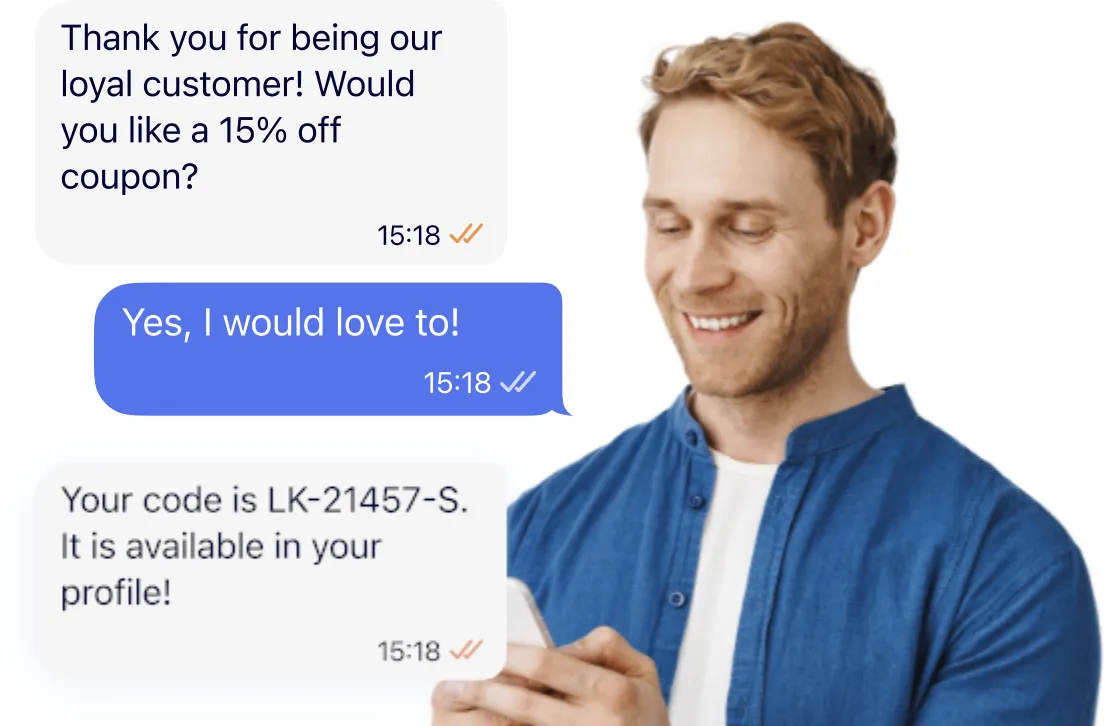
Unified loyalty programs create a data loop that benefits both sides. The customer gets recognized and rewarded. The brand gets behavioral data across touchpoints that makes future personalization more accurate. Messaging channels play a direct role here: a well-timed WhatsApp message notifying a customer that they are close to a reward threshold can drive both engagement and conversion in a single interaction.
7. Sustainability as a Value Driver
Sustainability has moved from a brand values statement to a purchasing criterion. A growing segment of consumers, particularly younger demographics, factor environmental and social responsibility into their buying decisions. Brands that demonstrate genuine commitment to sustainable practices are finding that it strengthens customer relationships rather than just satisfying a compliance or PR requirement.
For omnichannel marketers, the implication is that sustainability messaging needs to be consistent, specific, and present across all channels. A commitment to sustainable packaging that lives only on the website homepage is not an omnichannel strategy. That message needs to reach the customer at the point of purchase, in post-order communications, and in loyalty program framing. The consistency of the message across touchpoints is what makes it credible.
There is also a practical dimension. Brands are increasingly using messaging channels to communicate sustainability-related updates directly: shipment tracking that shows carbon offset information, notifications about take-back programs, and alerts about product recalls or ingredient changes. These are not marketing messages in the traditional sense. They are trust-building communications that happen to run on marketing infrastructure.
8. Enhanced Retail Media Networks
Retail media networks, the advertising ecosystems built on top of retailer first-party data, have become one of the fastest-growing segments in digital marketing. Major retailers including Amazon, Walmart, and Kroger have built significant advertising businesses by offering brands access to purchase-intent data that no other media channel can match.
The trend today is the expansion and sophistication of these networks. More retailers are building them. Existing networks are extending their reach beyond the retailer’s own properties into connected TV, programmatic display, and off-site channels. And the measurement capabilities are improving, making it easier to attribute in-store and online sales to specific campaign exposure.
For omnichannel marketers, the relevance is the data integration opportunity. Retail media activity generates signals about customer intent that can inform messaging across other channels. A customer who clicked on a sponsored product listing but did not purchase is a high-value candidate for a follow-up message via SMS or email. The channels work together when the data does.
9. Emerging Channels: Voice, CTV, and Retail Media
The omnichannel stack is expanding. Voice assistants, connected TV (CTV), and retail media are each adding new dimensions to how brands can reach and engage customers, and each brings its own data, behavioral signals, and interaction patterns.
Voice continues to grow as a commerce and service channel. Smart speakers and voice-enabled devices are used for product searches, reorders, and customer service queries. Brands that optimize for voice search and develop voice-based service experiences are reaching customers in moments and environments that text-based channels cannot.
CTV has shifted from a brand awareness medium into a performance channel. Viewers can now interact with ads, scan QR codes, and be retargeted across devices based on their viewing behavior. The data generated by CTV viewing is increasingly being used to inform messaging on mobile channels, closing the loop between the living room and the phone.
The emergence of these channels does not make existing channels obsolete. It raises the stakes for integration. A customer who sees a brand on CTV, searches via voice, and receives a follow-up SMS has had three distinct touchpoints. If those touchpoints are connected, the brand has built a coherent journey. If they are not, the customer has had three disconnected experiences with the same logo.
10. Composable and Headless Commerce Architectures
Traditional commerce platforms bundle the front-end customer experience with the back-end commerce logic in a single system. That approach is fast to deploy but slow to adapt. Composable and headless commerce architectures separate these layers, allowing businesses to choose best-in-class solutions for each function and connect them through APIs.
In a headless architecture, the storefront or customer-facing experience is decoupled from the commerce engine beneath it. This means a business can update the customer experience on one channel without rebuilding the entire platform, or add a new channel, such as a conversational commerce flow via WhatsApp, without replacing their existing infrastructure.
For omnichannel marketers, composable architecture is an enabler. It makes it practical to add new channels, swap out underperforming tools, and integrate new data sources without multi-year platform migrations. The businesses adopting this approach are building marketing infrastructure that can adapt to trends rather than lag behind them.
The Future of Omnichannel Marketing
The direction of omnichannel marketing is clear: more channels, more data, more automation, and higher customer expectations at every step. The businesses that will lead in this environment are not necessarily the ones with the largest budgets. They are the ones that treat integration as a strategic priority rather than a technical afterthought.
AI will continue to compress the time between customer signal and brand response. Emerging channels will add new surfaces for engagement. Privacy regulations will continue to reshape what data can be used and how. Each of these forces raises the value of having a connected platform underneath your marketing operation, one where customer data flows freely between systems and every channel benefits from what the others know.
The businesses building that infrastructure now are not preparing for a future state. They are responding to the expectations customers already have. The gap between what customers expect and what most brands deliver is still significant. Closing it is both the challenge and the opportunity that omnichannel marketing represents in 2026.
If you want to see how a connected messaging platform supports omnichannel strategies across SMS, WhatsApp, RCS, Viber, Telegram, email, and voice, [INTERNAL LINK: speak to a messaging expert at MMDSmart MessageWhiz].
Frequently Asked Questions
What are the top omnichannel marketing trends in 2026?
The leading omnichannel marketing trends in 2026 include AI-powered hyper-personalization, social commerce acceleration, phygital experiences, agentic AI and conversational commerce, unified data and privacy-first strategies, unified loyalty programs, sustainability as a value driver, enhanced retail media networks, emerging channels like voice and CTV, and composable commerce architectures. Together, these trends reflect a shift toward more connected, data-driven, and customer-responsive marketing operations.
What is the difference between omnichannel and multichannel marketing?
Multichannel marketing means communicating with customers across multiple channels. Omnichannel marketing means those channels are connected, sharing context and data so the customer experience is continuous rather than fragmented. The distinction is not the number of channels used but whether they work together as a unified system.
How is AI changing omnichannel marketing?
AI is enabling marketers to personalize communications at the individual level in real time, automating decisions about channel selection, message content, and send timing that previously required manual campaign management. Agentic AI is extending this further by enabling autonomous conversational commerce flows that can identify customer needs, respond to them, and complete transactions without human intervention at each step.
Why does privacy matter for omnichannel marketing in 2026?
The decline of third-party cookies and the expansion of privacy regulations globally have made first-party data strategies essential. Brands that build direct, consent-based relationships with customers through loyalty programs, opted-in messaging channels, and preference centers are generating more accurate and more compliant data than any third-party source can provide. Privacy-first marketing also builds customer trust, which has direct commercial value.
What role do messaging channels play in omnichannel marketing?
Messaging channels, including SMS, WhatsApp, RCS, Viber, Telegram, email, and voice, are the primary delivery layer for omnichannel customer communications. They carry the personalized, triggered, and conversational messages that bring an omnichannel strategy to life at the customer touchpoint. The intelligence lives in the CRM, customer data platform, or AI system. The messaging channel delivers it to the customer at the right moment, on the right channel, in the right format.