











Ecommerce teams know how to send messages. Order confirmations go out instantly. Shipping alerts fire on time. OTPs work. The operational layer is solid. What the data shows is that this operational strength is masking a much larger gap: most ecommerce teams are running a messaging strategy built for transactions, not for the kind of omnichannel, personalized communication that actually builds retention and drives revenue.
Omnichannel messaging for ecommerce means connecting SMS, RCS, WhatsApp, and other channels into a unified strategy where customer context follows every conversation, regardless of which channel it starts on.
The 2026 State of Digital Customer Communication Survey asked ecommerce leaders directly about their channel mix, integration maturity, and biggest operational challenges. Three clear patterns were revealed, highlighting the challenges facing retailers.
Why is omnichannel execution still so difficult in ecommerce?
The short answer is infrastructure. The ambition exists, as 65% of ecommerce leaders rate omnichannel engagement as very or extremely important. However, the platforms most of them are running today were not built to deliver it.
When asked what is preventing them from adopting a new messaging solution:
- 77% of ecommerce respondents cite a lack of unified functionality for true omnichannel communication
- 3% say their current platform does not support all the channels they need.
These reflect capabilities that were put in place for a narrower brief, and the business has outgrown them.
The gap appears in buying behavior too. When ecommerce teams evaluate a new messaging channel, omnichannel support ranks as their second-highest platform requirement, above analytics, workflow automation, and security. Your teams are looking for it, but they don’t have it.
The result is a strategy that looks coherent at the executive level and fragmented at the execution level. Customers move between channels, but messaging isn’t following them.
What does channel stagnation actually cost ecommerce brands?
An industry built on continuous optimization has quietly let its messaging channel mix go stale.
- Only 8% of ecommerce companies added a new messaging channel in the last six months.
- 13% percent have not added a channel in more than two years.
This matters because the evidence on new channels is clear.
Among ecommerce teams that did implement a new channel, 95% reported at least some increase in customer engagement. Not one respondent reported a decline.
The most commonly identified gaps point to where the opportunity sits:
- RCS: 48% of ecommerce teams identify it as a missing channel. Only 16% currently use it. RCS delivers branded, interactive messages directly in the native SMS inbox and supports rich media, confirmed delivery, and two-way conversation.
- WhatsApp: 26% identify it as a gap, despite its reach of over 2 billion users globally. For ecommerce brands operating in EMEA, LATAM, and APAC, WhatsApp is often where customers already are.
Ninety-seven percent of ecommerce respondents say they are likely to expand their channel mix in the next 12 months. The intent is clear. As they expand their channels, execution will catch up.
Channel comparison
| Channel | Best for | Rich media | Two-way | Ecommerce fit |
| SMS | OTPs, alerts, universal reach | No | Limited | High, transactional and time-sensitive messages |
| RCS | Branded campaigns, cart recovery, confirmations | Yes | Yes | High, interactive commerce in the native inbox |
| Service, support, conversational commerce | Yes | Yes | High, essential in EMEA, LATAM, APAC markets |
Why can’t most ecommerce teams personalize at scale?
Personalization requires tight integration between the communication tools and the CRM, AI agents, or business systems, and almost no ecommerce team that was surveyed has it.
- Only 16% of ecommerce respondents report full integration between their messaging platform and their CRM, AI agents, or other management systems.
- The remaining 84% are operating with a partial connection that lets some data through, but not enough to act on customer behavior in real time.
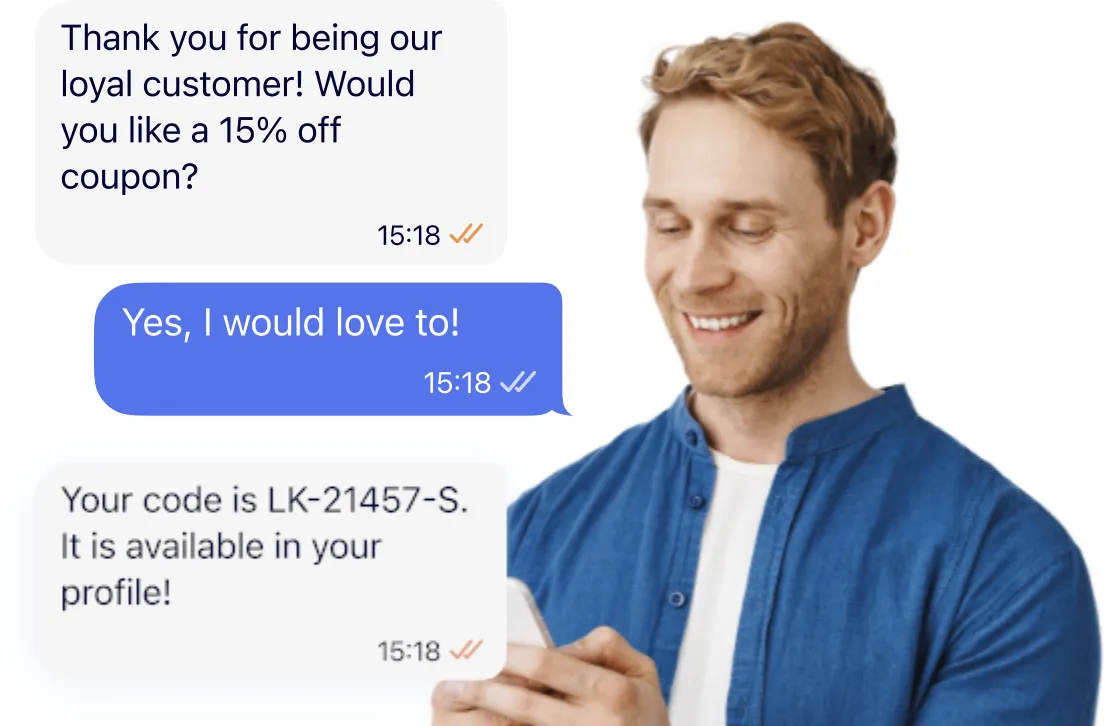
Ecommerce teams are highly capable at transactional messaging. Customer notifications and alerts are deployed by 90% of respondents. OTPs and account security messages by 79%. These work because they do not require behavioral data. They fire on a trigger, such as a purchase, a login, or checkout, and deliver reliably.
The gap shows up the moment personalization enters the picture. Only 19% of ecommerce companies currently use messaging for loyalty programs.
Bulk promotional messages dominate the mix at 42%, while individually targeted promotions sit at just 29%. The messaging strategy most ecommerce teams are running today is broad rather than behavioral.
The four challenges ecommerce teams report most often reflect exactly this:
- Low engagement or response rates: cited by 61% as a top challenge
- Managing conversations across multiple platforms: 52%
- Difficulty reaching customers on their preferred channels: 53%
- Limited personalization: 48%
These are symptoms of the same underlying problem: a messaging stack that holds customer data in one place and customer conversations in another, with an incomplete bridge between them. Real-time triggers, behavioral segmentation, lifecycle automation, and cross-channel personalization all require a tight integration.
When the connection between your customers’ behavior and your messaging platform is partial, even a well-designed campaign cannot act on what your customers actually did and want.
What role should AI play in ecommerce messaging?
AI in messaging is not just about generating content. It is about making every message arrive at the right moment, on the right channel, with the right context, automatically.
Nearly half of ecommerce teams (47%) say AI is very or extremely important when selecting a customer communication solution. The features they value most reflect where AI creates the clearest operational impact:
- Smart routing and timing of messages: valued by 66% of ecommerce respondents. This means AI determines not just what to send, but when and where — based on a customer’s behavior, channel preferences, and engagement history.
- Chatbot and virtual assistant capabilities: valued by 61%. For ecommerce, this covers everything from order status queries to returns processing to post-purchase support, handled automatically at scale.
- Message generation and content optimization: valued by 58%. AI-assisted content means campaigns can be adapted, personalized, and tested without manual production overhead for each variant.
The integration point matters here too. AI features only deliver their full value when the messaging platform has access to complete customer data. A smart routing engine cannot optimize message timing based on behavior if the behavioral data lives in a system that is only partially connected to the messaging platform. The AI capability and the integration requirement are essentially the same challenge viewed from two angles.
What does a connected ecommerce messaging stack look like?
An optimal stack does not mean more channels for the sake of it. It means each channel serves a specific purpose in the customer journey, triggered by real behavior, drawing on complete customer data from your CRM, AI agents, or other management systems.
The use cases where this combination creates the clearest value in ecommerce:
| Use case | Recommended channel | Trigger | What good looks like |
| Cart abandonment | RCS or WhatsApp | Checkout abandoned with items in cart | Interactive message showing cart contents with a one-tap return to checkout, sent within the hour |
| Order confirmation and shipping updates | SMS | Purchase completed / status change | Instant delivery to any handset, no app required |
| Post-purchase follow-up | Delivery confirmed | Conversational check-in with review request or cross-sell based on purchase history | |
| Loyalty program activation | RCS or WhatsApp | Customer reaches a tier threshold | Rich message with personalized reward, redeemable in one tap |
| OTP and account security | SMS | Login, payment verification | Immediate, reliable delivery with encrypted routing |
| Customer support | Inbound query or agent handoff | Full conversation history available to agent or AI assistant |
The common thread across every row is integration. The trigger fires from your CRM, AI agents, or other management systems. The channel choice is made based on what each customer responds to. The message content reflects what that customer has actually done. None of this works with a partial connection.
Turn Messaging Into a Competitive Advantage
The ecommerce teams that will extend their messaging capabilities in the next 12 months are not starting from scratch. They are closing a specific gap between the operational messaging they already run well and the behavioral, personalized communication that their own data tells them they need.
- 66% of ecommerce leaders expect messaging investment to increase over the next 12 months.
- 60% define messaging success by ROI.
The investment intent is real. The question is whether the infrastructure is in place to convert that investment into results.
MMDSmart MessageWhiz gives ecommerce brands the channel coverage, integration depth, and AI-ready infrastructure to close that gap; reaching customers on SMS, RCS, and WhatsApp, connected to your existing systems, with the real-time data access that personalization actually requires.
Download the Ecommerce Messaging Report, or explore the 2026 State of Digital Customer Communication Survey for findings across all industries.
Want to assess where your messaging stack stands today? Talk to the MMDSmart MessageWhiz ecommerce team.
FAQ
What is omnichannel messaging for ecommerce?
Omnichannel messaging for ecommerce means connecting your communication channels (SMS, RCS, WhatsApp, email, and others) into a unified strategy where context and customer history follow the conversation across channels. Unlike a multichannel approach, where each channel operates independently, omnichannel messaging allows a customer who abandons a cart to receive a WhatsApp follow-up, respond with a question, and complete the purchase, all within a single connected thread.
Why do ecommerce teams struggle with personalization at scale?
The most common cause is incomplete integration between the messaging platform and the CRM, AI agents, or other management systems that hold customer data. When that connection is only partial, behavioral triggers, real-time segmentation, and lifecycle automation cannot function as intended. The 2026 State of Digital Customer Communication Survey found that 84% of ecommerce companies report only partial integration, which means most personalization efforts are constrained before they begin.
What is RCS and why does it matter for ecommerce?
RCS (Rich Communication Services) is the next-generation successor to SMS. It delivers branded, interactive messages directly in a customer’s native message inbox, with support for images, carousels, confirmed delivery, and two-way conversation and no app download required. For ecommerce, RCS is particularly valuable for cart abandonment messages, order confirmations, and loyalty communications. In our survey, 48% of ecommerce teams identified RCS as a channel they are missing, but only 16% currently use it.
How important is AI in ecommerce messaging?
Increasingly important, but in a specific way. The most valued AI capabilities among ecommerce teams are smart routing and message timing (66%), chatbot and virtual assistant functionality (61%), and message generation and optimization (58%). The common thread is automation at scale, as AI helps the right message reach the right customer at the right moment without requiring manual effort for every interaction. AI features deliver their full value only when the messaging platform has complete access to customer data.
How do you measure success in ecommerce messaging?
The majority of ecommerce teams measure messaging success through a combination of ROI (60%), customer satisfaction scores (66%), and conversion rates (45%). Delivery rates and response rates are also tracked widely. The shift toward ROI and conversion as primary metrics reflects a broader move away from treating messaging as a utility channel and toward treating it as a direct revenue driver.
Data in this post is based on responses from ecommerce industry participants in the 2026 State of Digital Customer Communication Survey, conducted by Global Surveyz.