










Spain lifted the World Cup trophy this week, but if you run marketing, engagement, or customer communications for a brand, the real story of the tournament was never the final score. Over the past month, sportsbooks, travel companies, and retailers ran the largest live test of mobile engagement the world has seen, compressing years of use cases, sign-ups, roaming, live betting, and content, into a few weeks.
Your next global moment might not be a World Cup final, but it will demand the same thing from you: an omnichannel experience that reaches a customer’s phone fast, on the right channel, without asking them to download anything first.
An omnichannel engagement strategy for major sporting events is a plan for reaching fans across the channels they actually use, SMS, WhatsApp, RCS (Rich Communication Services), and email, matched to the right moment, so a brand can scale sign-ups, alerts, and verification without overwhelming any single channel.
Days before the final, MEF brought two other mobile executives and me together to unpack exactly what the shift toward native, no-download engagement already looks like.
What did the MEF panel say about World Cup 2026?
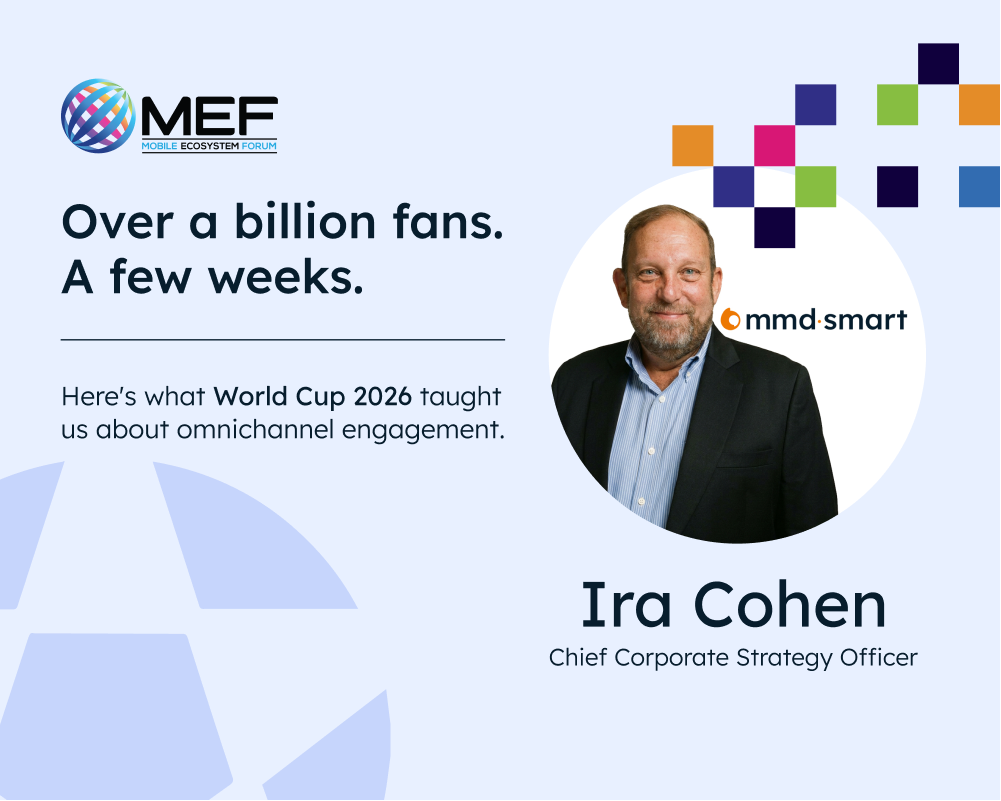
On July 2, I joined a MEF webinar titled ‘World Cup 2026: How Mobile Providers Are Engaging Fans and Fighting Fraud,’ alongside Marco Lafrentz, Vice President of Business and Market Development at Netnumber, and Nathan Robbins, Vice President of Strategy at Syniverse.
I argued that RCS was the tournament’s biggest missed opportunity. RCS is native to nearly every modern phone, which means a brand can reach a fan without asking them to download an app first, yet most World Cup campaigns ran on WhatsApp, TikTok, or plain SMS instead. Robbins pointed to the surge in cross-border roaming and data use as fans traveled between the US, Canada, and Mexico, and the growing role eSIM and one-time passcodes played in keeping that experience smooth. Lafrentz brought the risk side of the story: fake and invalid phone numbers spiking during sign-up and bonus traffic, evidence that the same reach brands were chasing was just as attractive to fraud.
What did World Cup 2026 show brands about reaching fans on mobile?
The tournament concentrated nearly every major mobile use case, ticketing, travel, live betting, and content, into a few compressed weeks. More than 1.2 million visitors traveled to the US, with another 5 million domestic travelers moving between host cities and average stays running close to 12 days.
That kind of surge is not new to a World Cup. Tim Green, who hosted the MEF panel, pointed back to the 2022 tournament in Qatar, where mobile data usage rose 26% and app installs spiked 70% on match days, evidence that this pattern repeats at scale every four years.
Yet for all that volume, brands barely used RCS. The infrastructure was ready well before kickoff: every major US carrier already supports it, and a brand using RCS does not need a fan to download anything to be reached. What lagged was adoption on the marketing side. My read was that marketers still are not being sold on RCS in language that makes sense to them, and unresolved pricing and fragmentation across countries have not helped either.
Which engagement tactics reached fans fastest during World Cup 2026?
I laid out three tactics that defined engagement during the tournament, and each one shows what fast, native mobile reach can do when a brand gets it right.
- In-play parlays and micro-bets. Bettors wagered on the next goal or the next card within seconds, using odds that updated through an API in real time and settling through autocash-outs before the next play even started.
- Sign-up bonuses. New-user incentives brought fans onto betting platforms quickly, and the operators using native, no-download channels captured that reach fastest.
- Geo-fenced in-stadium offers. A next-generation idea that is already taking shape: pairing AI-driven odds changes with GPS fencing to unlock stadium-only micro-bets for fans physically at the game.
Sportsbooks were not the only ones capturing this reach. Robbins described e-commerce retailers timing delivery updates around match breaks, and fans running interactive watch parties over WhatsApp and Telegram with families scattered across countries, proof that a tournament like this stretches mobile engagement far beyond any single industry.
Which messaging channel fits which job at a major event?
Not every channel is built for the same job, and the right mix looks different for outreach, engagement, and identity verification.
SMS remains the fastest way to reach a fan with no app or data connection required, which makes it the default for urgent alerts and one-time passcodes. WhatsApp carries richer, two-way conversation once a fan is already engaged, from order updates to live customer support. RCS sits between the two: it puts a brand’s verified name and rich media natively on a fan’s phone without an app download, though carrier support still varies in some places.
| Channel | Best for | Reach | Key capabilities |
| SMS | Urgent alerts, OTPs, time-sensitive updates | Near-universal, no app or data connection needed | Fast delivery, encrypted OTP verification |
| Rich, interactive engagement and two-way conversation | Very high in many markets outside the US | Interactive messages, media-rich campaigns | |
| RCS | Branded, native engagement without an app download | Growing across US carriers, still fragmented globally | Verified sender branding, rich media, native device presence |
What should brands do differently before the next major event?
World Cup 2026 was a preview, not an outlier. Tomorrow’s global moments, such as an Olympics, election night, or viral product launch, will compress the same mix of use cases into an even shorter window, and the brands that plan their channel strategy ahead of time will outperform the ones scrambling once volume spikes.
A few things worth building before the next moment hits:
- Reach fans without an app download. RCS puts your brand natively on a fan’s phone with verified sender branding, so you are not competing for one more app install during a high-attention week.
- Match the channel to the job. Use SMS or RCS for urgent, time-sensitive moments, WhatsApp for richer two-way conversation, and keep your highest-friction tasks, like identity verification, on the fastest channel available.
- Verify without slowing the funnel. An encrypted one-time passcode delivered by SMS or WhatsApp can confirm a phone number in seconds, without the document uploads most fraud prevention advice still leads with.
- Connect engagement to what you already know. Pairing channel activity with your CRM, AI agents, or other management systems lets you personalize the next message at the right time, based on their history, rather than treating every fan interaction as a blank slate.
World Cup 2026 will not be the last time a global event compresses a year of mobile engagement into a few weeks. Vendors like MMDSmart MessageWhiz give you SMS, WhatsApp, RCS, and Viber messaging, plus encrypted OTP verification, in one platform, so you’re ready for the next major event on the right channel, at the right time, instead of scrambling once it starts.