
















What Are CPaaS Providers?
Communications platform as a service (CPaaS) providers deliver cloud-based platforms that allow developers and businesses to embed real-time communication features such as voice, video, and messaging into their applications. Rather than building these communication tools from scratch, organizations can use CPaaS APIs and SDKs to quickly add capabilities like SMS notifications, voice calls, chatbots, and video conferencing to both web and mobile applications. This removes the need for specialized infrastructure or deep telecom expertise.
CPaaS providers manage the backend infrastructure, carrier connections, and scaling requirements, ensuring high reliability and uptime. By handling regulatory compliance, routing, and security, CPaaS solutions enable businesses to focus on user experience and application logic. The result is faster development cycles for communication-enabled applications, with reduced maintenance overhead and lower upfront investment compared to traditional methods.
This is part of a series of articles about CPaaS.
Core Features and Capabilities of CPaaS Providers
Communication Channels Supported
CPaaS providers offer a range of communication channels that can be integrated into business workflows and customer-facing applications. The most common channels include SMS, RCS, voice calls, video calls, email, and chat apps like WhatsApp, Telegram, or Viber. Many CPaaS platforms also support push notifications, group messaging, and multimedia sharing.
Having access to multiple channels from a centralized platform allows businesses to personalize and optimize interactions with customers. Unified APIs for these channels simplify integration, enabling developers to build omnichannel solutions that deliver consistent communication experiences regardless of the target medium.
For organizations that want to leverage messaging apps as part of their customer engagement strategy, WhatsApp for enterprise is one of the most widely adopted channels available through CPaaS platforms today.
Developer Toolkits
Developer support is a hallmark of leading CPaaS providers. They supply toolkits, including REST APIs, SDKs for popular programming languages, and low-code solutions that cater to varying developer abilities. Detailed documentation, sample code, and interactive testing environments further help streamline the integration process.
Pre-built templates, code snippets, and open-source libraries are often included to accelerate development. Many platforms support features like webhooks and event callbacks, enabling real-time response to communication events such as message delivery or call status updates.
Scalability, Global Reach, Carrier Interconnects
A key advantage of CPaaS platforms is their ability to scale alongside customer needs. These providers maintain redundant global infrastructure to handle traffic spikes, regional expansions, and evolving use cases. Automated provisioning allows businesses to scale services up or down without manual intervention, ensuring network reliability and uninterrupted service delivery.
To guarantee worldwide coverage, CPaaS providers establish direct relationships with numerous telecom carriers and local aggregators. Carrier interconnects enable businesses to send SMS, voice, and other communications to nearly any destination, often providing localized sender IDs, compliance support, and optimal message routing for speed and deliverability.
Security and Regulatory Compliance
Security is a central focus for any business handling customer communication. Reputable CPaaS providers integrate encryption protocols, access controls, and fraud detection mechanisms to safeguard message content and user data. Features like two-factor authentication, secure webhooks, and role-based access management bolster platform security.
Equally important is regulatory compliance in various jurisdictions. CPaaS providers typically adhere to standards such as GDPR, HIPAA, and PCI DSS where required. They implement processes for data residency, consent management, and lawful intercept.
Integration With Other Systems
Effective CPaaS platforms do more than offer communication APIs; they also enable integration with existing business systems like CRMs, ERPs, marketing platforms, and customer support tools. This interoperability allows for use cases such as automated appointment reminders, contextual customer service, and triggered notifications based on CRM data.
Integrations often extend to workflow automation tools or iPaaS (integration platform as a service) solutions, making it possible for non-technical users to link CPaaS capabilities to business processes without coding. This approach streamlines end-to-end communication flows, enhances productivity, and centralizes reporting and analytics across enterprise systems.
Related content: Read our guide to CPaaS solutions
Notable CPaaS Providers
1. MessageWhiz

MessageWhiz is a performance-driven CPaaS provider that combines programmable messaging and voice APIs with operator-grade telecom infrastructure. Unlike many CPaaS platforms that abstract delivery behind aggregators, MessageWhiz operates as a telecom transit operator, controlling routing and interconnects end-to-end. This enables higher delivery rates, faster connections, and greater reliability for SMS, voice, and messaging across global markets.
Built for both developers and business teams, MessageWhiz provides flexible APIs alongside ready-to-use applications for messaging, voice, and call center workflows. AI is embedded across routing, monitoring, and analytics layers, allowing customers to optimize delivery, adapt to real-time conditions, and gain deeper insight into communication performance. This makes MessageWhiz well suited for high-volume, latency-sensitive, and revenue-critical use cases where delivery quality directly impacts outcomes.
Key CPaaS capabilities include:
- Programmable messaging and voice APIs: APIs for SMS, voice calling, WhatsApp, and other messaging channels, enabling developers to embed communications into applications, workflows, and customer journeys
- Operator-grade global routing and carrier interconnects: Direct control over routing paths as a telecom transit operator, delivering higher completion rates, lower latency, and improved international deliverability compared to reseller-based CPaaS platforms
- AI-driven routing and delivery optimization: AI continuously analyzes traffic patterns, destination performance, and congestion signals to optimize routing decisions in real time
- Omnichannel orchestration: Coordinate SMS, WhatsApp, email, and other channel interactions from a unified platform, supporting seamless transitions between channels while preserving context
- Advanced analytics and monitoring: Real-time dashboards and reporting for delivery success, failure reasons, latency, and traffic performance across channels and regions
- AI-powered sentiment and interaction insights: Analyze conversations to detect sentiment trends, identify delivery or experience risks, and surface actionable insights for operations and support teams
- Flexible integration options: Webhooks, event callbacks, and CRM integrations enable real-time automation, triggered messaging, and alignment with existing business systems
- Scalable, secure cloud infrastructure: Designed to support high-throughput traffic with redundancy, compliance support, and enterprise-grade reliability
Why MessageWhiz stands out among CPaaS providers
While many CPaaS platforms focus primarily on API breadth, MessageWhiz differentiates by combining programmability with direct telecom control. This allows businesses to build communication workflows that are not only flexible, but also optimized for real-world delivery performance. For organizations where message delivery, call quality, and routing reliability are mission-critical, MessageWhiz offers a CPaaS foundation designed for measurable results, not just connectivity.
2. Twilio

Twilio CPaaS provides APIs to embed omnichannel communications into existing apps and services, including messaging, voice, and contact center capabilities.
Key features include:
- Omnichannel APIs: Offers APIs to integrate communications directly into applications, enabling messaging and calling across channels within existing systems rather than separate tools or standalone deployments.
- Cloud contact center (Flex): Provides a configurable cloud contact center to connect customers with agents or sales teams, extending CPaaS use cases into service workflows and live assistance scenarios.
- Marketing orchestration (Twilio Engage): Includes tooling to create personalized omnichannel campaigns with
- customer data platform integration, focused on targeted marketing journeys and audience engagement capabilities.
- Voice notifications: Supports automated outbound voice reminders and informational messages for transactional and operational use cases, exposed through programmable voice interfaces.
- Phone intelligence (Lookup): Exposes real-time phone number data for validation and risk reduction to improve deliverability and reduce fraud during communication and onboarding flows.
Source: Twilio
3. Vonage
Vonage Contact Center is a cloud-based contact center platform built on a microservices architecture. It focuses on reliability, scalability, security, and compliance with global standards, and offers operational transparency and certification for Chrome environments.
Key features include:
- Microservices architecture: Uses a modular, microservices-based design to roll out new functionality continuously, minimize outage risk with built-in resiliency, and support updates without monolithic release cycles.
- Performance monitoring and reliability: Runs ongoing tests for call delivery, routing, agent login, and administration, compares results to defined thresholds, and invests in automation, traffic management, monitoring, and alerting across service layers.
- Elastic scalability and global availability: Operates in a cloud environment with distributed, redundant computing, scaling on demand and supporting global expansion through worldwide data center infrastructure and availability.
- Simplified provisioning and onboarding: Adds new licenses without additional hardware or downloads, enabling contact centers to scale up or down quickly and provision new agents.
- Security and compliance: Implements security controls and supports compliance with ISO 27001, HIPAA, SOC 2 Type II, PCI DSS, and GDPR, including support for Salesforce Shield deterministic encryption.
Source: Vonage4. Infobip

Infobip CPaaS X is a modular API stack for platforms. It introduces automation for provisioning and onboarding, offers a unified API across channels with orchestration and failover, and supports granular reporting with global carrier connectivity and compliance expertise.
Key features include:
- Unified API across channels: Provides a single API stack for all channels, enabling easier adoption of new channels and simplified integration without maintaining separate interfaces for SMS, RCS, and chat applications.
- Messages API with orchestration and failover: Unifies channel sequencing and automatic failover, allowing messages to reach customers on the most effective channel without editing content when delivery paths change or interruptions occur.
- Automated provisioning and onboarding: Provides granular APIs for automating resource provisioning, campaign registration, and client-specific consumption reporting, plus automated client onboarding and number provisioning to accelerate initial setup and traffic activation.
- Client-level configuration and reporting: Enables per-client configuration and delivers reports by customer, use case, or resource, with event subscriptions to receive only the notifications relevant to specific operational needs.
- Reduced engineering effort: Targets lower operational load by unifying APIs, increasing automation opportunities, and minimizing custom development required to integrate new channels or manage provisioning and reporting processes.

Source: Infobip
5. Webex

Webex Connect is a centralized cloud communications platform for orchestrating customer interactions across 16 channels. It integrates with existing systems, provides a low-code visual flow builder, and emphasizes enterprise-scale infrastructure, security, centralized control, and real-time reporting.
Key features include:
- Omnichannel coverage: Supports 16 communication channels, including SMS, RCS, WhatsApp Business, MMS, and WebRTC, enabling consistent customer interactions across messaging and digital touchpoints from a centralized platform.
- System integration: Integrates with existing backend systems, cloud applications, and partner services to orchestrate interactions and use existing data and investments during customer journeys.
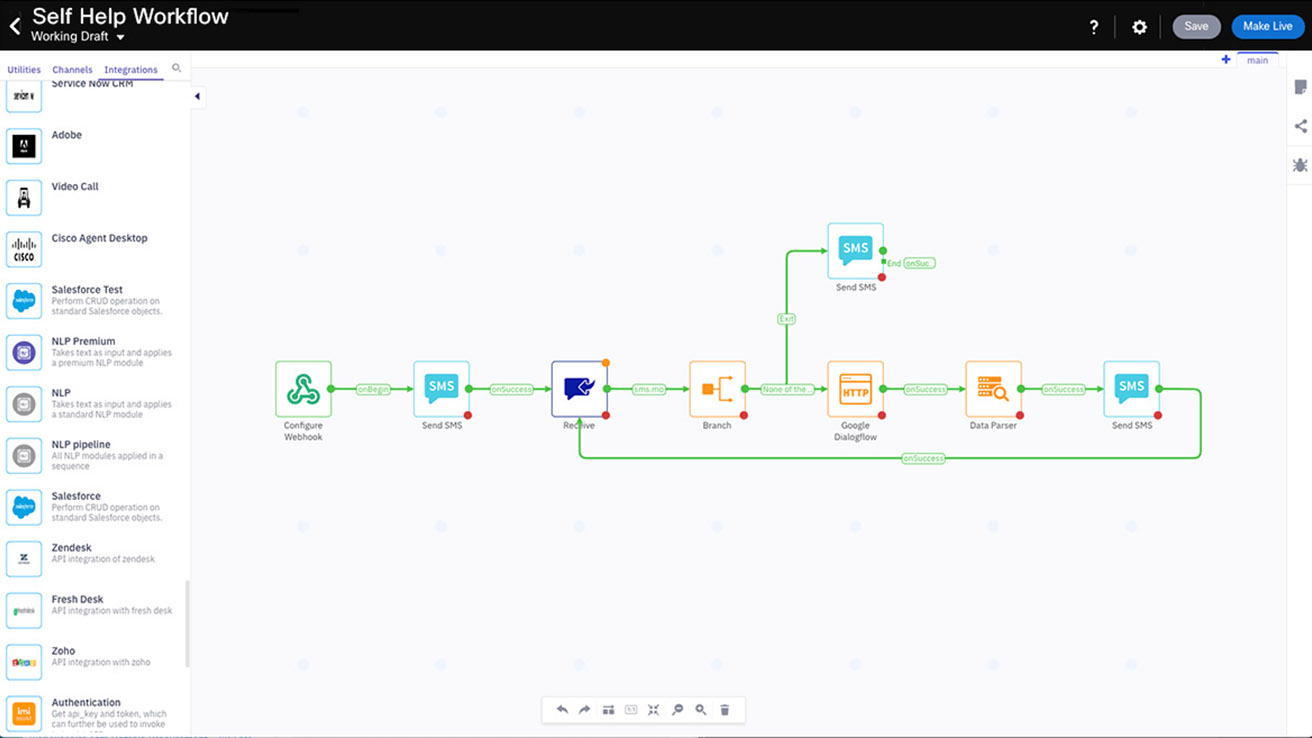
- Low-code journey builder: Provides a low-code visual flow builder with drag-and-drop tools to build interactive journeys faster, reducing complex code and lengthy development cycles for deploying communication workflows.
- Enterprise-grade infrastructure and security: Operates on enterprise-grade infrastructure designed for scale, adds new channels as they emerge, and maintains security practices aligned with regulations to support compliant cloud communications.
- Centralized control and reporting: Centralizes management of customer interactions, offering real-time reporting to optimize customer journey performance and security controls to protect data and support compliance requirements.
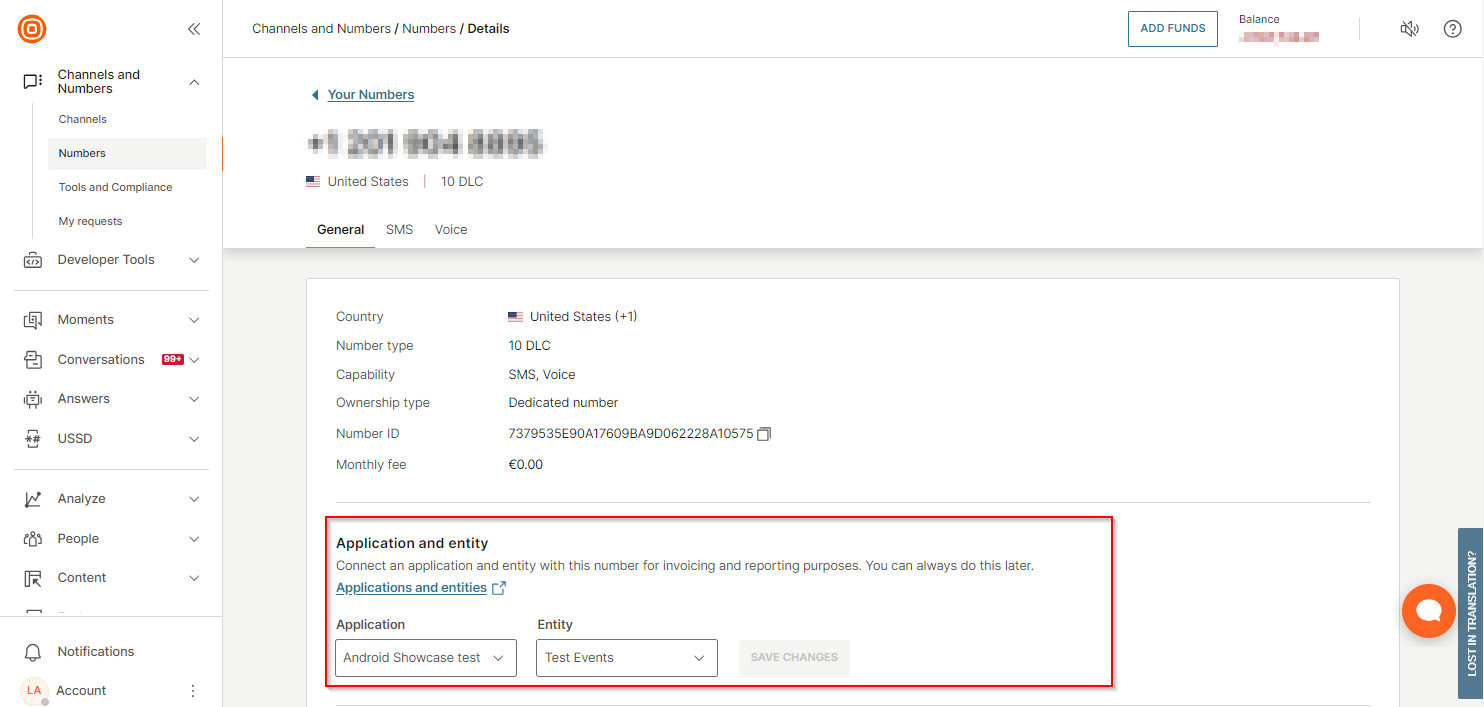
- Prebuilt applications: Includes Webex Campaign for campaign automation, Webex Engage for live agent chat across digital channels, and Webex Notify for outbound notifications to reduce call volumes.

Source: WebexKey Considerations When Choosing CPaaS Providers
When evaluating CPaaS providers, businesses should go beyond surface-level features to assess how well a platform aligns with their technical, operational, and strategic needs. Below are critical factors to consider:
- API reliability and documentation: The quality, consistency, and uptime of APIs are fundamental. Look for providers with detailed, up-to-date documentation, clear versioning, and active developer communities. SDK support across multiple platforms is also important.
- Global reach and latency: Confirm the provider has infrastructure in regions where you operate. Global points of presence (PoPs) help minimize latency and ensure local compliance for message delivery and phone number provisioning.
- Channel breadth and depth: Some CPaaS platforms offer broad channel coverage, while others specialize in fewer but deeper integrations. Consider what channels (SMS, voice, WhatsApp, etc.) your use case requires and assess how well they are supported.
- Scalability and performance under load: Evaluate the platform’s ability to handle peak loads and support growth. Look for providers with auto-scaling, queuing mechanisms, and SLAs that reflect real-world traffic patterns.
- Security and compliance support: Ensure the provider supports required compliance frameworks (e.g., GDPR, HIPAA, PCI DSS) and offers features like encryption at rest and in transit, secure webhooks, and granular access control.
- Pricing model and transparency: Pricing should be predictable and aligned with usage patterns. Examine how providers charge for different channels, number provisioning, and geographic reach. Watch for overage fees and bundled rates that may obscure true costs.
- Support and SLAs: Look into the level of technical support offered (24/7, dedicated engineers, response times). SLAs should guarantee uptime, latency, and message delivery, with financial penalties for non-compliance.
- Integration ecosystem: Consider how well the CPaaS platform integrates with your existing tools (e.g., CRMs, helpdesks, automation platforms). Prebuilt connectors and support for webhooks or event-driven workflows reduce implementation time.
- Analytics and monitoring: Robust analytics help track message delivery, failure rates, and user engagement. Dashboards, real-time logs, and alerting capabilities are valuable for debugging and performance tuning.
- Vendor stability and roadmap: A provider’s financial health, innovation pace, and product roadmap are important for long-term alignment. Check for regular updates, acquisition risks, and investment in emerging communication standards.
Conclusion
CPaaS providers give businesses the tools to embed communication capabilities directly into applications without managing telecom infrastructure. By offering scalable APIs, robust developer resources, and global communication networks, they help accelerate development and improve customer engagement across channels. Choosing the right CPaaS partner involves balancing technical fit, compliance, global coverage, and support capabilities to meet current and future communication needs.