














What Are Call Center Solutions?
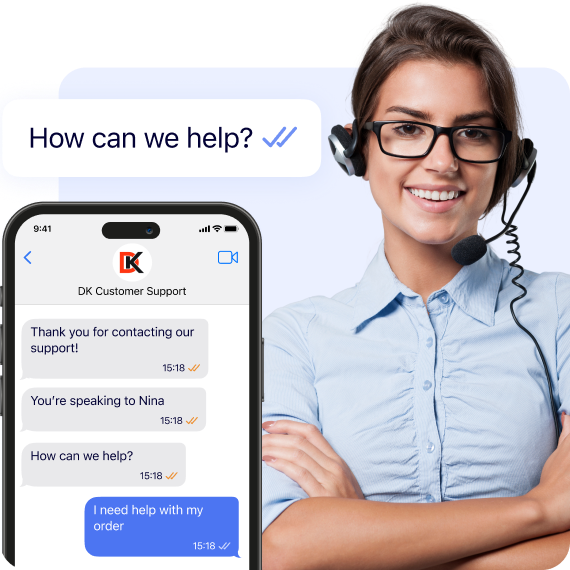
Call center solutions are technology platforms and software suites to manage and improve customer service center operations. These solutions centralize and automate inbound and outbound communication channels, allowing organizations to handle large volumes of customer interactions efficiently. Call center solutions offer tools for managing calls, chats, emails, SMS, and social media interactions from one platform, ensuring consistent customer experiences across multiple channels.
These solutions are not just about routing calls; they encompass workforce management, analytics, reporting, CRM integration, and agent assistance tools. The primary goals are to maximize first-contact resolution, minimize wait times, improve agent productivity, and elevate overall customer satisfaction. The right call center solution aligns with an organization’s requirements, ensuring scalability, security, and compliance, regardless of size or industry.
Key Features and Technologies Provided by Call Center Solutions
Omnichannel Support
Omnichannel support allows call centers to interact with customers via their preferred communication channels, including voice calls, email, SMS, webchat, and social media platforms. A true omnichannel solution integrates these various channels into a unified agent interface, so agents can transition between conversations or channels without losing context or history. This results in a smoother customer experience and more informed agent responses.
With omnichannel support, organizations can track and analyze all interaction points, helping improve customer journey mapping and predict future needs. Agents have full visibility into customer history, reducing repetitive explanations and improving overall problem resolution speed. This integration is critical for organizations looking to deliver consistent, high-quality support across all customer touchpoints.
VoIP
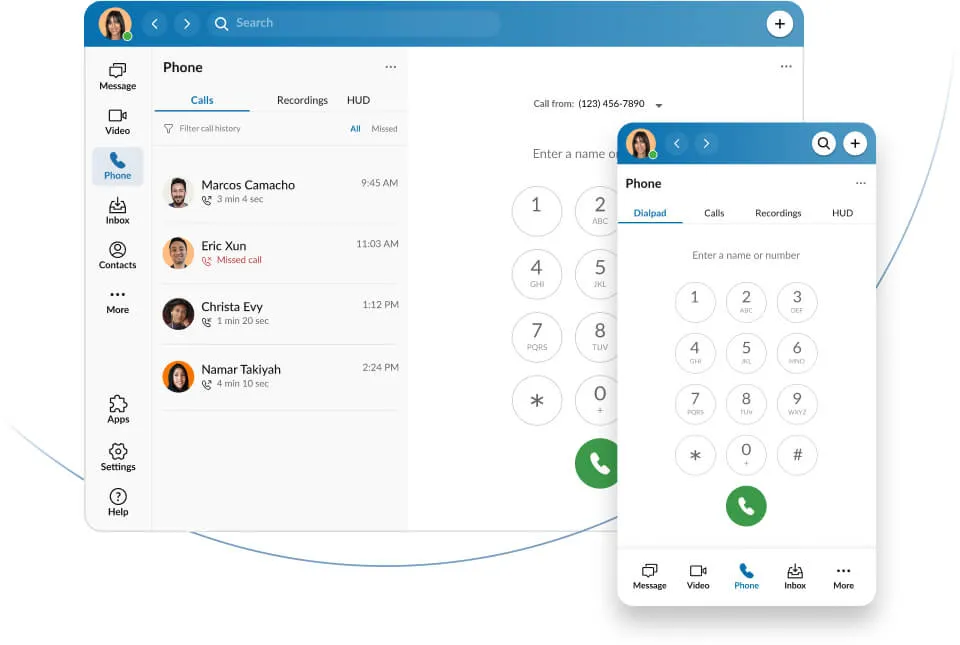
Voice over internet protocol (VoIP) technology allows call centers to transmit voice calls over the internet, removing the need for traditional handset-based phone lines or expensive telecom infrastructure. VoIP-driven call center solutions are typically more cost-effective, scalable, and flexible compared to legacy phone systems. They support a distributed workforce by allowing remote agents to connect from anywhere with an internet connection.
Additionally, VoIP solutions offer features such as call recording, dynamic caller ID, and flexible phone number management. These features simplify compliance, training, and quality assurance processes, while supporting rapid scaling of call center operations as needed. VoIP enables organizations to integrate voice communications with other digital channels, paving the way for broader digital transformation initiatives.
Automatic Call Distribution (ACD)
Automatic call distribution (ACD) systems ensure inbound calls are routed to the most appropriate agent or department based on pre-defined rules, such as agent skillset, customer priority, or current call queue lengths. By automating call distribution, ACD optimizes both agent utilization and customer wait times. This leads to faster resolutions, more personalized service, and greater overall efficiency.
ACD technologies can integrate with CRM systems, IVR menus, and workforce management tools to route calls based on customer data or previous interaction history. With these integrations, customers receive service from agents best suited to handle their needs, increasing satisfaction and reducing call transfers or escalations. Modern ACD systems provide granular insights and reporting capabilities, allowing for ongoing optimization of routing strategies.
Interactive Voice Response (IVR)
Interactive voice response (IVR) systems automate initial caller interactions by prompting callers to select menu options or provide information using voice or keypad inputs. IVR streamlines call flows, enabling self-service for common inquiries such as account balances, order statuses, or password resets without requiring agent intervention. This reduces agent workload and shortens customer wait times.
Modern IVR systems can be integrated with backend systems for personalized responses and support, such as authenticating customers using caller ID or account details, and routing calls to specialized agents when needed. They may also incorporate speech recognition technology for natural language interactions, further improving accessibility and customer experience. Well-designed IVR flows help balance automation efficiency with the option to escalate to live agents.
AI and Automation
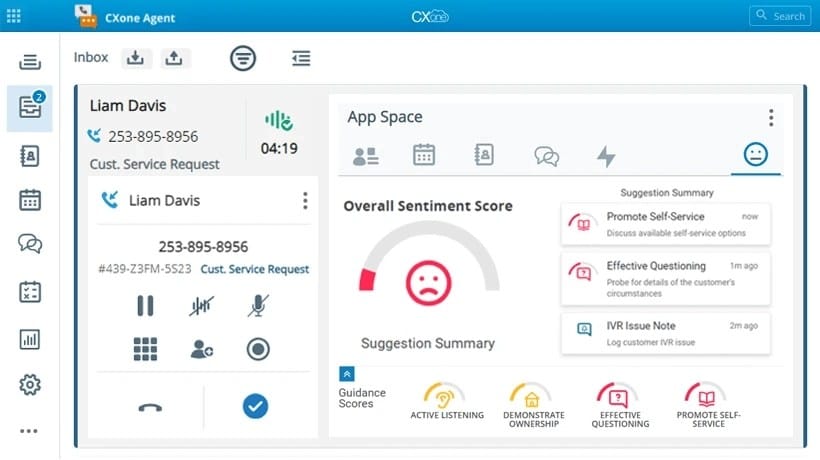
AI-driven sentiment analysis enables real-time evaluation of customer emotions during interactions. If the system detects signs of frustration, confusion, or dissatisfaction, it can automatically alert supervisors or escalate the case. This proactive approach allows managers to intervene early, reducing customer churn and supporting agent coaching. Sentiment tracking also helps identify patterns in customer behavior, leading to improvements in scripts, workflows, and product offerings.
Automation capabilities such as predictive dialers and smart inbound call routing enhance both outbound and inbound operations. Auto-dialers optimize agent time by automatically calling a list of leads and only connecting answered calls to agents. Smart routing leverages AI to match callers with the most appropriate agents based on interaction history, sentiment, or issue complexity. These features increase call throughput, reduce idle time, and elevate overall service quality.
Analytics
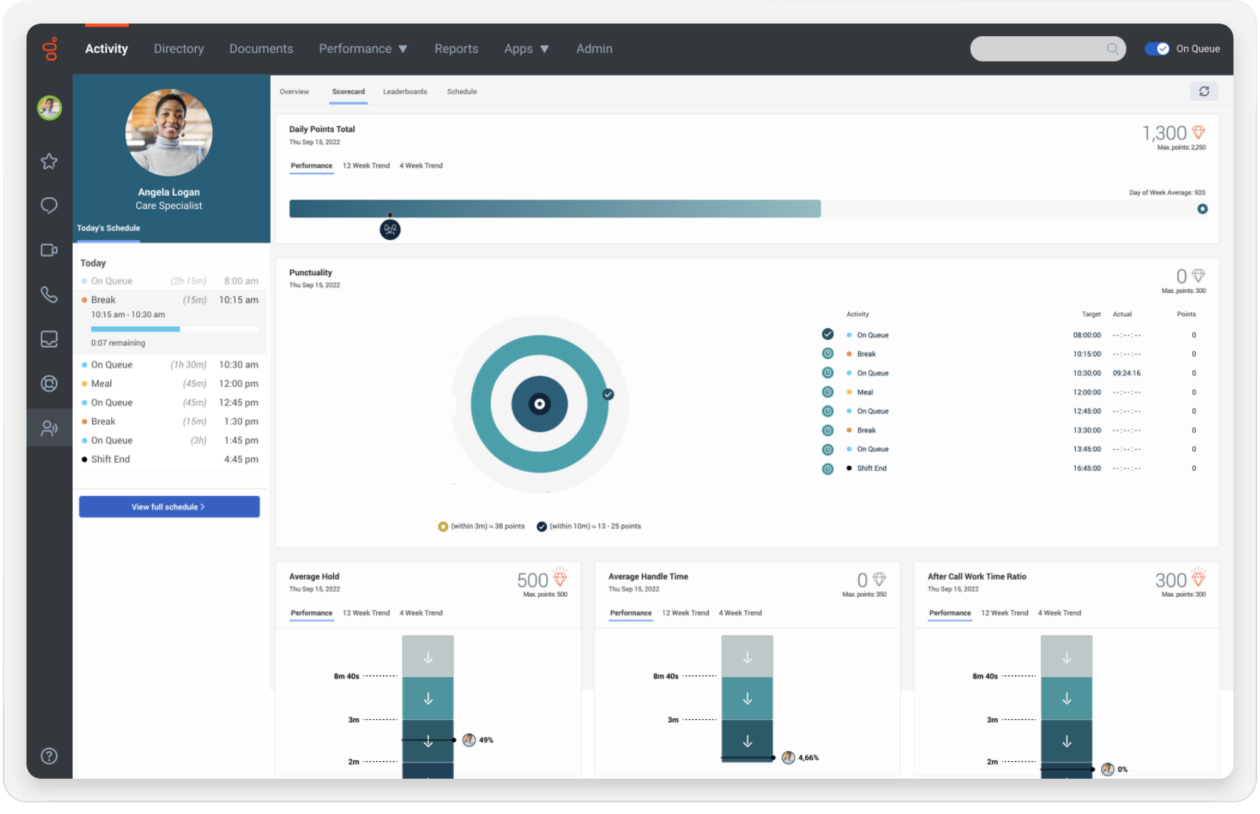
Analytics platforms in call center solutions offer deep insights into call volumes, agent performance, customer satisfaction, and operational efficiency. These systems collect and analyze data on key metrics such as first call resolution rates, average handle time, abandonment rates, and customer feedback scores. Supervisors and managers can use this data to identify trends, track agent productivity, and optimize workforce scheduling.
Real-time dashboards and historical reports help organizations make informed decisions, set performance targets, and quickly diagnose issues such as unusually high call volumes or agent bottlenecks. Advanced analytics might include sentiment analysis, speech analytics, or predictive modeling, enabling continuous improvement of processes and enhanced customer experience strategies.
CRM Integration
Customer relationship management (CRM) integration ensures agents have access to relevant customer data, interaction history, and account details directly within the call center platform. This reduces duplication, limits the need to switch between systems, and provides critical context for every interaction. Integrated CRMs help agents personalize service, resolve issues faster, and track case progress more efficiently.
CRM-connected call center solutions enable automated logging of customer interactions, streamlined ticketing, and real-time data syncing between support, sales, and marketing departments. This alignment drives better collaboration, more consistent communications, and actionable insights from a unified data source, ultimately contributing to a more holistic customer experience.
Types of Call Center Solutions
On-Premise Call Center Solutions
On-premise call center solutions are installed and managed within an organization’s own IT infrastructure and physical location. These systems are maintained by in-house technical teams and typically require upfront investment in hardware, licenses, and networking components. On-premise solutions offer high customizability and direct control over data security, compliance, and integration with other business systems.
However, on-premise solutions often come with higher maintenance overhead, longer deployment times, and reduced scalability compared to cloud-based alternatives. They may be best suited for large organizations with specific regulatory requirements or highly sensitive data environments. Migration or updates can be complex, and remote or distributed workforce support may require additional configuration or VPN setups.
Cloud-Based Call Center Solutions
Cloud-based call center solutions are hosted on external servers and delivered via the internet, eliminating the need for costly on-site hardware and infrastructure. Deployment is typically fast, with organizations able to scale their workforce up or down as needed, and remote agents can access the platform from anywhere. These solutions offer high levels of redundancy, uptime, and automatic software updates managed by the vendor.
Cloud call centers enable integration of emerging technologies like AI, analytics, and omnichannel support. They support rapid innovation, easier management, and lower total cost of ownership. Security and compliance are handled through robust cloud protocols, making them suitable options for most industries, but organizations with very tight data sovereignty requirements may still prefer on-premise systems.
Hosted Call Center Solutions
Hosted call center solutions represent a mix between on-premise and cloud approaches. In this setup, the core infrastructure is hosted and managed offsite by a third-party provider but may be customized and dedicated to a specific organization. The customer typically pays a service fee for access, while benefiting from reduced hardware maintenance and external expert support.
Hosted solutions provide flexibility and scalability similar to cloud-based solutions, but with greater opportunities for customization and integration with legacy systems. Businesses that need a personalized but hands-off infrastructure solution may favor hosted call centers. However, uptime, feature updates, and redundancy will depend on the capabilities and support level of the hosting provider.
Virtual / Remote Call Center Solutions
Virtual or remote call centers are designed for distributed workforces where agents operate from varied locations, often home offices, rather than a central facility. These solutions leverage cloud technologies and softphone systems, ensuring secure access to all call center tools and customer data regardless of location. Remote call centers offer flexibility in staffing and can adapt easily to surges or drops in call volume.
The shift to virtual call centers accelerates hiring from wider talent pools and supports business continuity in the event of disruptions to physical office locations. Security, data privacy, and remote agent management become higher priorities in virtual setups, so robust communication, monitoring, and performance analytics tools are essential. Virtual models are now standard for many modern organizations, helping optimize costs and employee satisfaction.
Inbound Call Center Solutions
Inbound call center solutions focus primarily on handling incoming customer service calls, queries, support requests, and order inquiries. Their core components include automatic call distribution, interactive voice response, and skills-based routing to ensure callers are quickly connected to the best-qualified agent. These solutions are critical for businesses prioritizing responsive support and high first-contact resolution rates.
Enhanced inbound call centers may integrate voice analytics, self-service IVR menus, and CRM systems for streamlined, personalized experiences. Key performance metrics include average wait time, abandonment rate, and customer satisfaction scores. Inbound call centers are essential in industries like finance, healthcare, and retail, where reliable customer support directly impacts brand reputation.
Outbound Call Center Solutions
Outbound call center solutions are built to handle outgoing calls for sales, lead generation, surveys, collections, or follow-ups. They employ features like predictive dialing, call scripting, and campaign management to increase agent productivity and optimize connection rates. Outbound solutions help companies efficiently reach large audiences with targeted messages and support proactive customer engagement strategies.
Compliance with regulations (such as TCPA or GDPR) and opt-out management is critical in outbound environments. These solutions often integrate with CRM and analytics platforms to monitor campaign performance, track sales metrics, and adjust strategies in real time. Outbound call centers are common in telemarketing, political outreach, and proactive customer retention applications.
Automated Call Center Solutions
Automated call center solutions leverage technology to handle repetitive tasks and streamline workflows without the constant involvement of human agents. These systems use tools like IVR, chatbots, and automated ticketing to manage routine inquiries, appointment scheduling, payment processing, and status updates. By automating common interactions, businesses can reduce operational costs, free up agents for more complex issues, and improve response times.
Advanced systems incorporate AI and natural language processing (NLP) to manage dynamic conversations and provide contextual answers. Integration with backend systems allows automation to fetch or update customer data in real time, creating a seamless self-service experience. These solutions are especially valuable in high-volume environments where scale and consistency are critical to customer satisfaction and business efficiency.
Notable Call Center Solutions
1. MessageWhiz

MessageWhiz delivers a cloud-based call center solution built on operator-grade telecom infrastructure, designed for organizations that cannot afford dropped calls, poor routing, or fragmented customer conversations. Unlike most CCaaS platforms that rely on third-party carriers, MessageWhiz operates as a telecom transit operator, controlling voice routing end-to-end. This allows businesses to achieve consistently higher call quality, faster connection times, and greater reliability across global markets.
MessageWhiz services combine inbound and outbound call handling with messaging channels such as SMS and WhatsApp, enabling true omnichannel engagement from a single vendor. With real-time analytics, CRM integrations, and flexible routing logic, MessageWhiz supports customer service, sales, and operations teams that require both scale and precision. The result is a call center solution optimized not just for features, but for delivery performance, control, and measurable outcomes.
Key capabilities include:
- Operator-grade voice routing with AI optimization: MessageWhiz controls routing end-to-end as a telecom transit operator, while AI continuously optimizes routing decisions based on destination performance, congestion patterns, and historical delivery outcomes
- AI-enhanced inbound and outbound call handling: Improve queue management, prioritize high-value or urgent calls, and optimize outbound dialing efficiency using AI-driven logic rather than static rule sets
- Real-time sentiment analysis during calls: AI analyzes voice signals and conversational patterns to detect customer sentiment such as frustration, confusion, or satisfaction while calls are in progress, enabling proactive intervention
- Sentiment-based escalation and prioritization: Automatically flag or escalate calls when negative sentiment is detected, allowing supervisors to intervene or route conversations to more experienced agents before issues escalate
- Omnichannel voice and messaging orchestration: Manage voice calls alongside SMS and WhatsApp conversations in a unified environment, with AI preserving context and sentiment across channels to reduce customer friction
- Intelligent routing informed by sentiment and history: Route callers based on interaction history, prior sentiment trends, customer attributes, and real-time signals to improve first-contact resolution
- AI-driven analytics and sentiment insights: Track sentiment trends across agents, queues, regions, and campaigns to identify systemic issues, training gaps, or process breakdowns
- CRM-integrated agent intelligence: Surface customer data, interaction history, sentiment indicators, and recommended next actions directly within agent workflows
- Continuous quality monitoring and optimization: Use sentiment data to identify recurring issues, dropped-call risk, or negative experience drivers, enabling ongoing performance improvements
- Global scale with local intelligence: Combine carrier-grade global infrastructure with AI- and sentiment-driven performance tuning to maintain call quality and customer experience across international markets

2. Zendesk

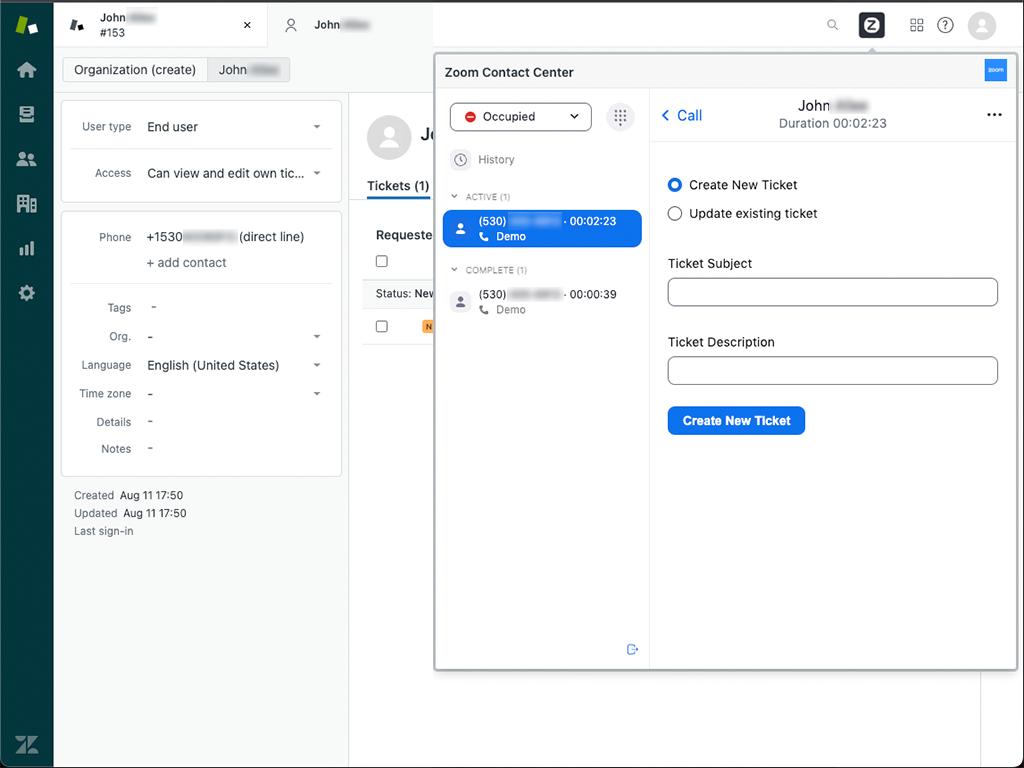
Zendesk Contact Center is an AI-powered, enterprise-grade contact center solution built on the Zendesk Resolution Platform. It unifies voice, digital, and self-service channels in a single workspace where AI, agents, and workflows operate together.
Key features include:
- AI-centered platform: Built on Zendesk Resolution Platform with AI embedded across channels to coordinate agents, workflows, and self-service for resolving customer requests without separate middleware components.
- Voice infrastructure: Provides secure, scalable voice capabilities on AWS infrastructure, bringing telephony features into the same environment as digital channels for global deployments and centralized operations management.
- Voice AI agents: Uses Zendesk Voice AI, trained on service interactions, to handle parts of calls, guide callers through steps, and give agents suggested responses and context during conversations.
- Agent workflows: Supports designing guided workflows that combine tickets, knowledge content, and automation steps so agents can follow structured processes and reduce manual navigation between separate tools.
- Customer insights: Surfaces insights from voice interactions, including summarized notes and suggested next actions, to support compliance-heavy use cases and refine procedures across regulated environments.
- Zendesk ecosystem connections: Connects with Zendesk capabilities such as messaging, ticketing, knowledge base, reporting, workforce management, and quality assurance through shared platform services and configuration options.
3. Five9

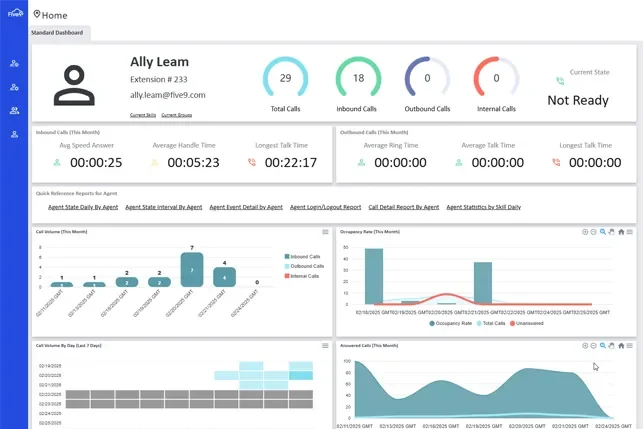
Five9 is a cloud contact center platform that provides tools for digital engagement, AI-driven automation, workforce optimization, and multichannel communication. It supports agent productivity and offers options for customer self-service across channels.
Key features include:
- Collaborative intelligence: Combines agent interactions with AI-driven automation to support service delivery and offer customers additional options for managing their inquiries across channels.
- Practical AI: Uses applications such as intelligent virtual agents and real-time agent assist to automate routine interactions and deliver coaching that supports consistent handling of customer conversations.
- Workforce optimization: Provides capabilities to manage staffing levels, review agent activity, and adjust workloads to maintain operational consistency across changing contact volumes and service requirements.
- Choice of channels: Supports communication through voice, email, chat, SMS, and social messaging, maintaining interaction continuity when customers move between different contact methods.
- Digital engagement: Offers tools for handling customer interactions in digital environments, enabling agents to work from a consolidated interface that organizes conversations and supports efficient responses.
- Real-time insights: Collects interaction data and surfaces operational information that organizations can use to monitor performance indicators and adjust processes for improved contact handling.
Source: Five9
4. Talkdesk

Talkdesk is an AI-powered cloud contact center and customer experience automation platform that combines Talkdesk CX Cloud and Industry Experience Cloud. It provides applications for self-service, omnichannel engagement, workforce engagement, employee collaboration, and customer experience analytics.
Key features include:
- AI-powered customer experience automation: Provides AI agents across CX Cloud and Industry Experience Cloud to automate service, sales, and support steps, coordinating tasks across the customer journey and internal operations.
- Omnichannel engagement and self-service: Offers tools for voice and digital channels with automation to maintain context between interactions, while self-service applications handle common questions so agents can focus on more complex issues.
- Industry-specific experience clouds: Provides pre-built contact center products for sectors such as banking, insurance, healthcare, retail, government, and education, with pre-integrated systems, predefined workflows, automation, and domain-focused AI models.
- Integrations and marketplace: Supports over seventy out-of-the-box integrations with collaboration, crm, and industry platforms, and an AppConnect marketplace offering more than one hundred add-on solutions for workforce optimization and related capabilities.
- Workforce engagement and collaboration: Includes tools for workforce engagement, management, and employee collaboration, using automation and organizational features to coordinate agents, managers, and decision makers in both centralized and distributed workplaces.
- Customer experience analytics: Provides analytics and automation capabilities to track inbound and outbound interactions, generate insights about customers and conversations, and support monitoring of performance trends across channels and contact center operations.
Source: Talkdesk
5. Nextiva

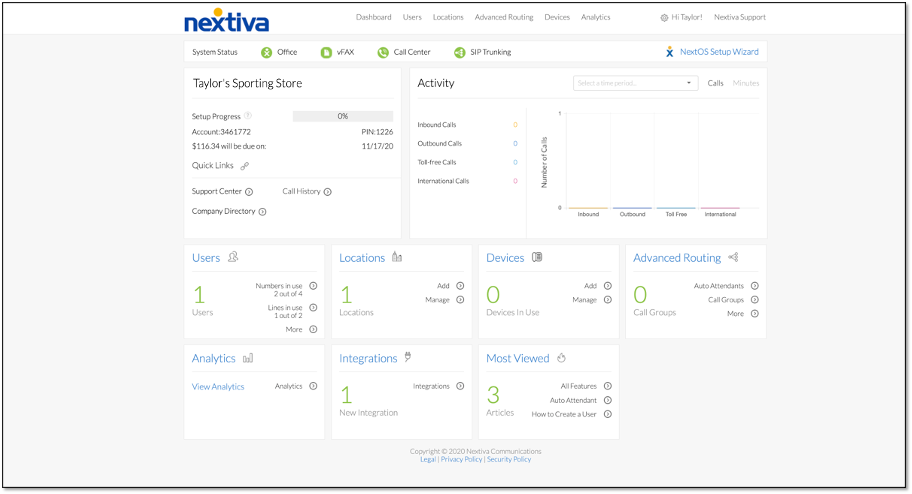
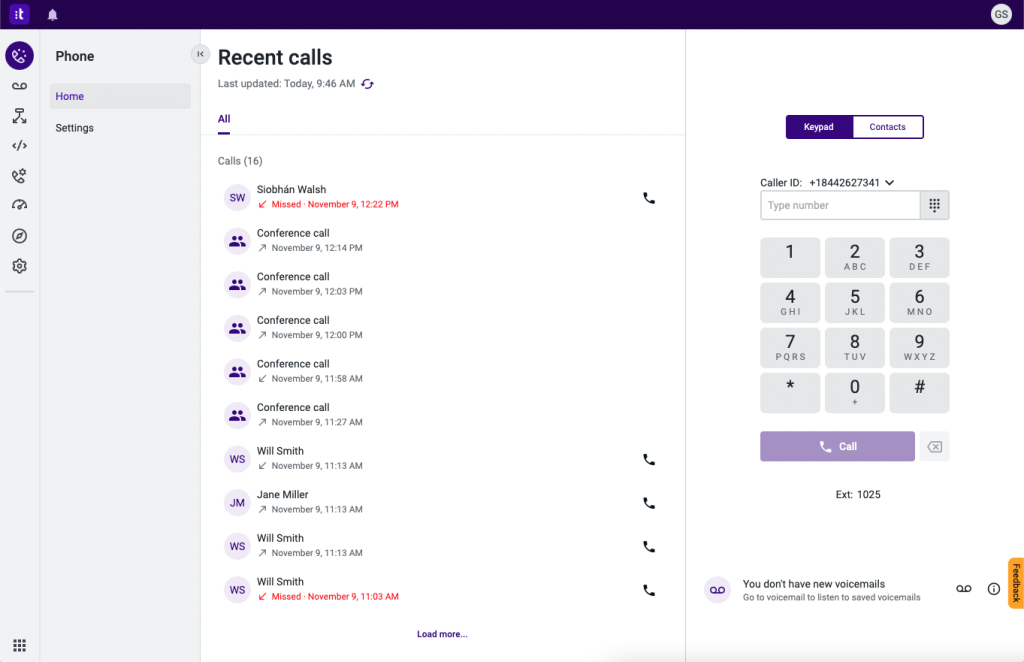
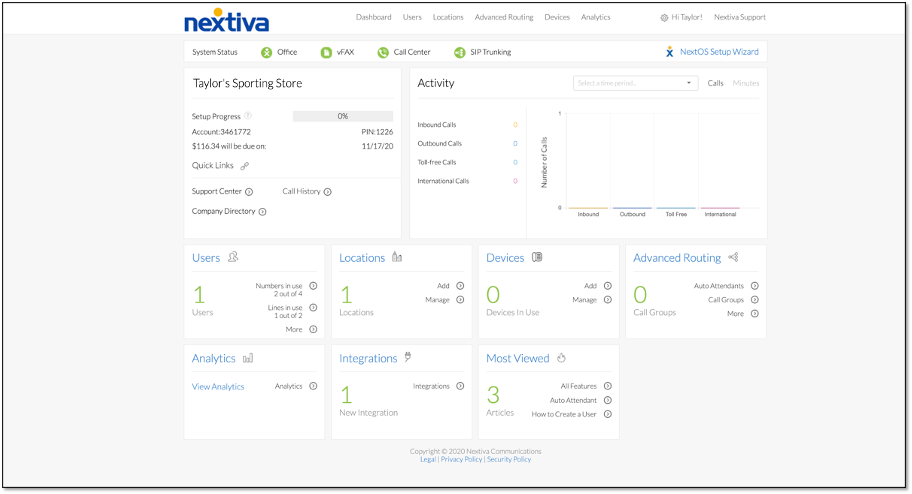
Nextiva is a cloud-based VoIP call center and contact center platform that offers omnichannel engagement, routing, automation, analytics, and workforce capabilities for inbound, outbound, and blended customer interactions.
Key features include:
- Cloud contact center platform: Provides VoIP-based call center capabilities with per-agent, usage-based, and concurrent pricing models for voice and web chat, including inbound, outbound, and blended customer interactions.
- Omnichannel engagement and routing: Offers omnichannel capabilities, workflow engine for journey orchestration, transcription, summarization, and configurable intelligent, skills-based routing limits that expand from entry plans to higher tiers.
- Outbound and self-service tools: Adds email, SMS, progressive and predictive dialing, list and campaign management, dynamic scripting, customer surveys, and proactive outbound notifications for outreach and self-service workflows.
- Dashboards, reporting, and analytics: Provides real-time dashboards, reporting, and advanced customer experience analytics integrations, including support for multiple dashboards, wallboards, and connections to external business intelligence tools in upper tiers.
- Automation and self-service: Includes workflow builder, process automation, simple and advanced self-service bots, full API access, omnichannel conversation history, contact management, web callback, and automatic call distribution callbacks.
- Workforce and quality management: Offers single-screen recording, enhanced supervisory capabilities, workforce management options, geographic disaster recovery features, and secure payment agent assist with PCI-DSS support for handling payment information.
- Reliability, mobility, and analytics platform: Uses enterprise-focused VoIP infrastructure with multiple points of presence, mobile applications for remote work, and voice analytics features for monitoring call activity and performance.
Source: Nextiva
6. Aircall

Aircall is a customer communication and intelligence platform that provides call center software for sales and support teams. It focuses on call handling, analytics, routing, collaboration, and reporting across voice and related channels.
Key features include:
- Call monitoring and coaching: Provides live call monitoring with AI-generated insights so supervisors can review interactions, guide agents during conversations, and propagate quality improvements consistently across the team.
- Call center analytics: Centralizes metrics like wait times, missed calls, and call volumes so teams track performance, adjust staffing, and identify trends affecting customer satisfaction and operational decision-making.
- Call routing and distribution: Supports configurable distribution rules and ring strategies so calls reach appropriate team members quickly, using crm integration to preserve context and enable more targeted, personalized interactions.
- Threaded and contextual conversations: Provides a single view of conversations across voice and text channels so agents see history, maintain continuity, and understand previous touchpoints before responding to customer queries.
- Collaboration and task automation: Offers tools that gather teams around shared customer information, while automating repetitive tasks so agents spend time communicating and less time manually logging or updating records.
- Integrations and extensibility: Connects with CRM and sales tools such as OnePageCRM, enabling call data synchronization, follow-up workflows, and reporting that link telephony activity with broader sales or support processes.

Source: Aircall
7. Twilio Flex

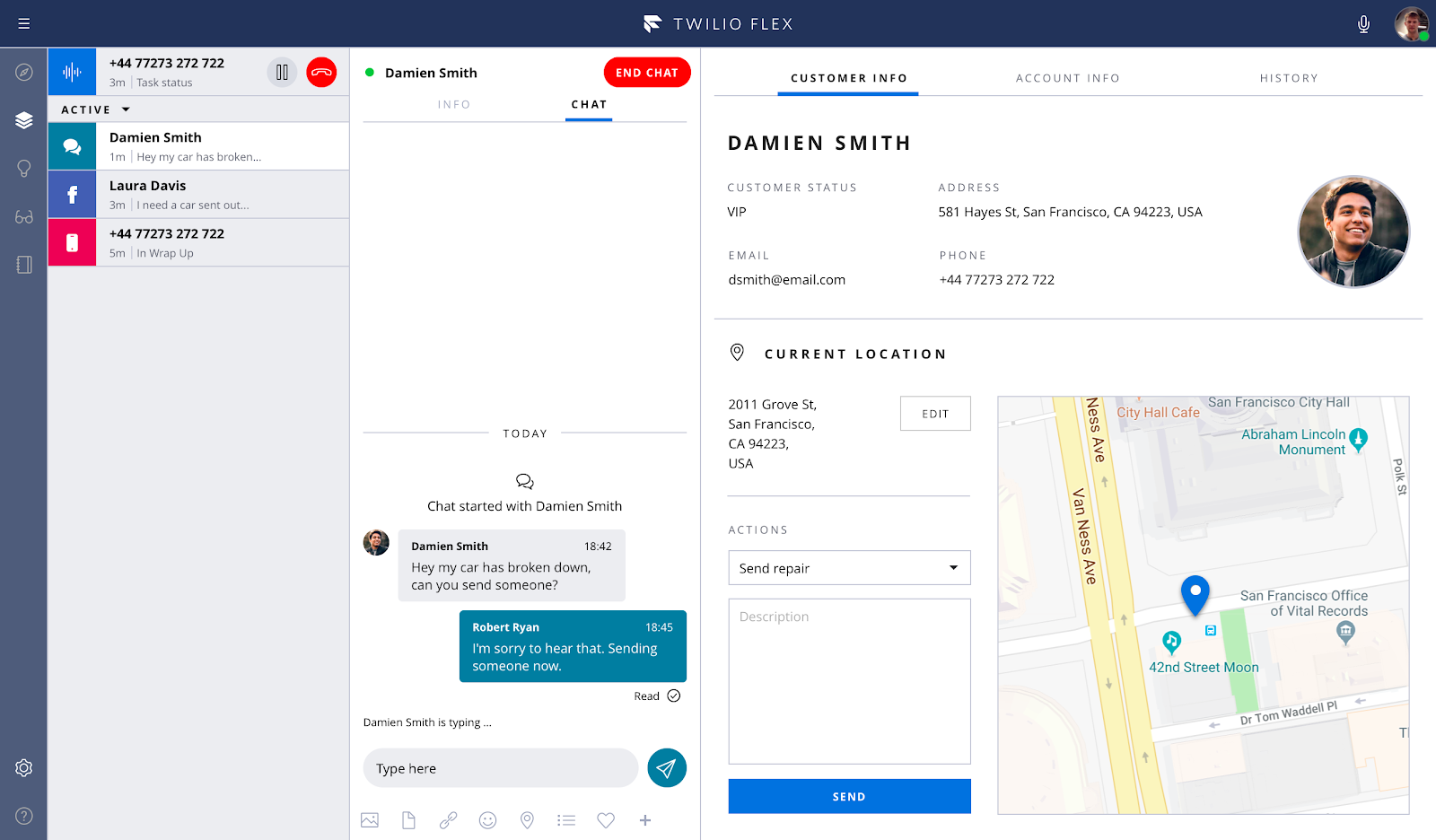
Twilio Flex is a cloud contact center platform focused on digital customer engagement and configurable workflows. It can augment or replace existing call center systems, adding omnichannel communication, customizable interfaces, routing, and reporting aligned to specific operational needs.
Key features include:
- Flexible deployment and integration: Works alongside existing contact center systems, adding new digital channels and capabilities while connecting to current technology stacks so organizations can modernize contact handling incrementally.
- Unified agent workspace and data: Lets representatives handle tasks from a single interface, surfacing first-party customer information from multiple systems so they can view context and manage interactions consistently.
- Omnichannel engagement options: Supports SMS, WhatsApp, voice, Facebook Messenger, web chat, and additional channels so customers can start or continue conversations on their preferred communication methods.
- Intelligent routing and IVR: Uses TaskRouter to assign tasks automatically with escalation and fallback rules, and augments existing systems with configurable interactive voice response flows for directing inbound calls.
- Bring your own carrier support: Allows organizations to keep their current PSTN voice carriers and phone numbers while connecting them to Flex, preserving existing telephony arrangements during migration or expansion.
- AI assistance and analytics: Integrates with Google Contact Center AI to suggest responses, and includes Flex Insights for analyzing conversations, tracking KPIs, and building custom dashboards on contact center performance.
- Self-service and extensible architecture: Supports configurable self-service flows and plugin-based extensions so teams can customize UI elements, reporting, and workflows according to their contact center requirements and development preferences.

Source: Twilio
8. NICE CXone

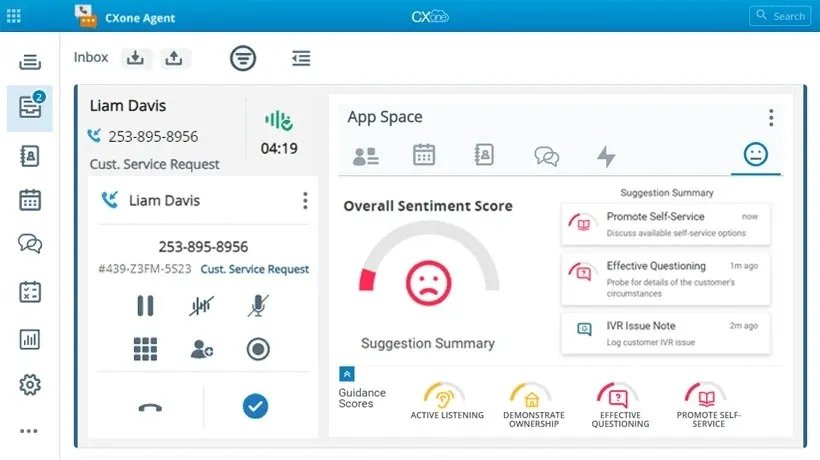
NICE CXone Mpower is a cloud contact center software platform that combines automatic call distribution, IVR, analytics, and AI-focused capabilities to manage customer interactions across voice and digital channels. It supports inbound and outbound communication strategies, workforce engagement, and integration with CRM and other business systems.
Key features include:
- Cloud contact center platform: Provides CXone Mpower as a cloud-based contact center suite with automatic call distribution, call recording, monitoring, analytics, and support for inbound and outbound voice operations.
- Omnichannel and self-service capabilities: Supports voice and over thirty digital channels, using interactive voice response and digital self-service tools so customers access information and assistance on their preferred communication methods.
- AI and journey orchestration: Uses Enlighten AI for CX, journey orchestration, and call routing features to personalize self-service and agent experiences while using customer data to optimize interaction handling.
- Workforce engagement and agent assist: Provides workforce engagement management, visibility, and gamification, plus AI-driven agent assist tools that guide employees in real time and support targeted coaching based on interaction analytics.
- Open cloud platform and marketplace: Offers an open cloud architecture with core modules, APIs, and CXexchange marketplace applications, enabling integration with third-party systems and extension of contact center capabilities without custom builds.
- Analytics, quality, and feedback tools: Includes detailed analytics, reporting, quality management, and feedback management capabilities so organizations measure service levels, review interactions, and adjust processes using structured performance and survey data.
- Scalable operations and high-volume handling: Designed to manage high call volumes for global operations, using IVR, routing, and cloud infrastructure so contact centers handle fluctuating demand without redesigning core systems.
 Source: NICE
9. Genesys Cloud CX

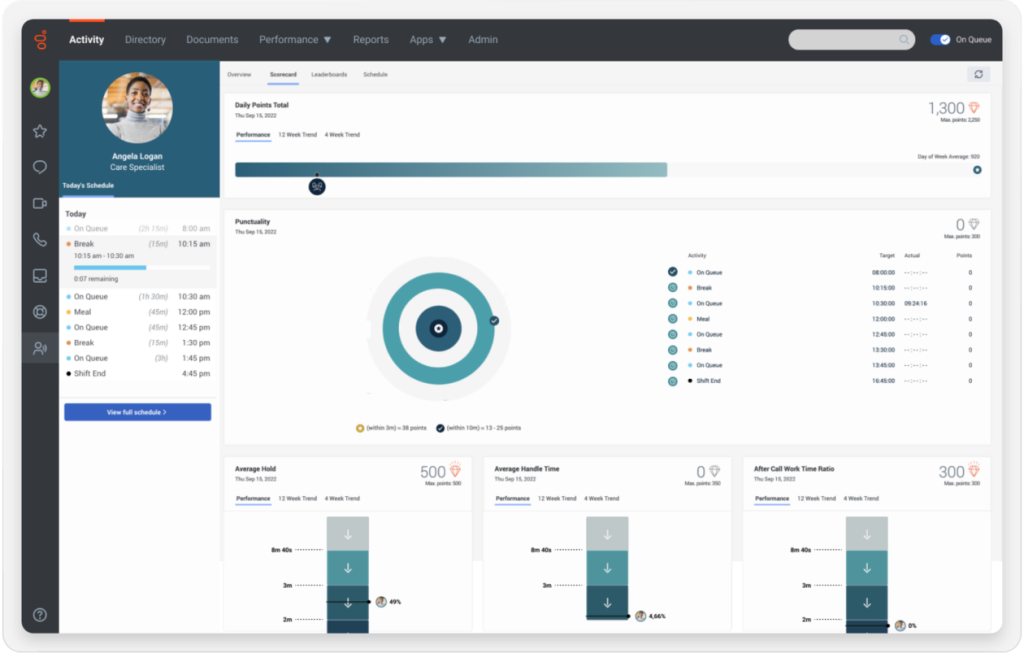
Genesys Cloud CX is an AI-powered Contact Center as a Service (CCaaS) platform that unifies voice, digital engagement, workforce engagement, analytics, and journey orchestration in a single cloud architecture. It provides tools for managing inbound and outbound interactions, automating workflows, and personalizing customer experiences through AI, APIs, and integrations.
Key features include:
- Automatic call distribution and intelligent routing: Supports skills-based and AI-driven routing so customers connect with the agent best suited to address their needs, optimizing resolution outcomes across channels.
- Omnichannel engagement: Enables communication via voice, email, chat, SMS, social media, and co-browse, consolidating all interactions into a unified platform with complete history and context.
- IVR and self-service tools: Provides configurable interactive voice response and AI-powered virtual agents so customers can resolve inquiries independently, improving efficiency and reducing agent workload.
- AI assistance and automation: Includes AI-based agent copilots, predictive routing, predictive engagement, work automation, and knowledge management tools to guide both customers and employees in real time.
- Analytics and reporting: Offers interaction analytics, speech and text analytics, customer journey analytics, and customizable dashboards to monitor performance and identify trends for improvement.
- Workforce engagement management: Supports forecasting, scheduling, quality monitoring, coaching, and performance management to optimize employee experience and operational efficiency.
- Open platform, integrations, and marketplace: Built on a cloud-native, API-first architecture with access to more than 600 apps and integrations through AppFoundry, including CRM integrations such as Salesforce.
- Global availability and compliance: Provides secure and scalable cloud operations across more than 100 countries with advanced security, compliance controls, and enterprise-grade reliability.
Source: Genesys
10. RingCentral RingCX

RingCentral RingCX is an AI contact center platform that combines omnichannel communication, virtual agents, workforce engagement, outbound campaigns, and analytics in a single workspace. It is delivered as a cloud service with integrated RingEX collaboration, consolidated licensing, and high-availability infrastructure to support distributed support teams.
Key features include:
- AI conversation engine: Uses AI Conversation Expert at the core of RingCX to generate insights, automate tasks, and provide assistance across self-service, live interactions, and supervisory workflows.
- Omnichannel engagement: Supports voice and more than twenty digital channels in a single license, enabling agents to manage conversations from one workspace and maintain continuity as interactions move between channels.
- AI self-service and assist: Provides intelligent virtual agents for voice and digital self-service, plus AI Agent Assist and Supervisor Assist for real-time guidance, suggested responses, and coaching during active conversations.
- AI workforce engagement: Includes AI-powered quality management, automated scorecards, interaction analytics, and workforce management features to assess performance, understand sentiment, and align staffing and coaching with contact center activity.
- Outbound campaign management: Offers preview, progressive, predictive, and voice broadcast dialers with campaign tools so teams can reach leads, collect payments, or deliver proactive notifications from one environment.
- Dashboards, reporting, and recordings: Provides live dashboards, over two hundred fifty pre-built reports, custom analytics views, call and screen recordings, and chat transcripts to monitor performance and evaluate customer journeys.
- Integrations and open APIs: Connects with fifty-plus integrated tools and supports over five hundred APIs, enabling CRM integrations, digital channels, and custom workflow builders aligned with contact center requirements.
Source: RingCentral
Best Practices for Implementing Call Center Solutions
1. Establishing KPIs and Performance Baselines
Defining clear key performance indicators (KPIs) and baseline metrics is vital for measuring the effectiveness of call center solutions. Organizations should identify core metrics such as first call resolution, average handle time, customer satisfaction (CSAT), and agent utilization rates before launching or upgrading their solution. These baselines provide necessary visibility into current performance while informing realistic improvement targets.
By tracking KPIs over time, management can detect trends, diagnose pain points, and prioritize process or technology changes for maximum impact. Consistent measurement ensures resource allocation and technology investments align with business goals such as increased efficiency, higher customer loyalty, or reduced operational costs.
2. Building Effective Routing Logic and Escalation Paths
Effective call routing and escalation design ensure inquiries reach the most qualified agents quickly, minimizing transfer rates and reducing resolution times. This requires mapping customer needs, agent skills, and support tiers, then configuring call distribution rules (whether via ACD, skill-based routing, or AI-powered systems) accordingly. Logical, data-driven routing improves both agent productivity and customer satisfaction.
Establishing clear escalation paths is equally important for handling complex or high-priority issues. Explicit rules for when to escalate to senior agents, supervisors, or specialists help prevent bottlenecks and improve customer outcomes. Continuous review and optimization of routing and escalation flows can further streamline operations and maintain service quality as demands change.
3. Optimizing Agent Workflows and Reducing Handle Time
Efficient agent workflows are essential to delivering quick, high-quality service. This involves integrating relevant systems, such as CRM, knowledge bases, and call controls, into a unified agent desktop to eliminate data silos and redundant tasks. Workflow automation and contextual prompts can guide agents through common processes, reduce manual data entry, and streamline case management.
Regular training and feedback loops support continuous improvement by identifying workflow pain points and upskilling agents in best practices. Leveraging analytics to monitor average handle times and pinpoint inefficiencies helps organizations iterate processes and maximize throughput. Optimized workflows enhance both customer experiences and agent satisfaction by removing friction and cognitive overload.
4. Ensuring Data Quality and CRM Alignment
High-quality data and tight alignment between call center and CRM systems are foundational for effective customer interactions. Clean, up-to-date customer records ensure agents have the necessary context for personalized, efficient service, while reducing the likelihood of duplicated tickets or misrouted cases. Automated data synchronization and validation processes are critical to maintaining accuracy across systems.
Periodic audits, data hygiene practices, and clear policies for record updates help sustain data quality in the long term. Proper CRM alignment facilitates centralized reporting, better segmentation, and more actionable insights across departments. When call center and CRM data are unified, organizations can execute deeper analytics, more personalized outreach, and comprehensive support strategies.
5. Continuous Monitoring, Testing, and Iteration Cycles
Implementing call center solutions requires an ongoing commitment to monitoring, testing, and iterative improvement. Real-time dashboards, periodic audits, and regular analytics reviews help teams stay alert to performance trends, emerging issues, or technology gaps. Proactive monitoring reduces downtime and ensures swift response to incidents or shifting customer demands.
Continuous iteration, using insights from performance data and customer feedback, enables organizations to refine workflows, adjust KPIs, or scale features as needed. A culture of experimentation, supported by testing new features or routing strategies in controlled environments, leads to more resilient and adaptive call center operations. This approach ensures solutions remain aligned with evolving business needs and customer expectations.
Conclusion
Call center solutions are no longer limited to basic telephony: They now encompass a broad range of technologies that drive efficiency, improve customer satisfaction, and support strategic business goals.
Whether deployed on-premise, in the cloud, or through hybrid models, these platforms integrate voice, digital channels, analytics, and automation to streamline operations and personalize customer experiences. Choosing and implementing the right solution requires aligning tools with organizational needs, ensuring system integration, and committing to ongoing optimization.