















What is AI Call Center Software?
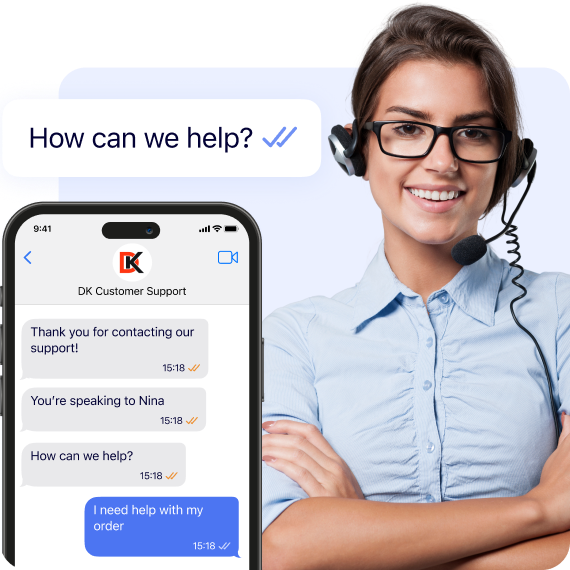
AI call center software refers to platforms that use artificial intelligence technologies, such as generative AI and AI-driven automation, to manage, enhance, and streamline call center operations. Unlike traditional phone systems, these solutions handle a wide range of tasks, from automated customer interactions and intelligent routing to providing live insights and support for human agents. The core function is to improve both the efficiency and effectiveness of customer service through advanced data analysis and automation.
These AI-powered solutions are designed to not only automate routine tasks but also provide real-time assistance to agents, enabling faster and more accurate responses. They continuously learn from new interactions, making self-service options more robust, and help resolve common issues autonomously. The goal is to reduce operational costs, minimize call handling times, and deliver improved customer experiences.
This is part of a series of articles about call center solutions.
6 Key Capabilities of Modern AI Call Center Systems
1. Intent Detection and Automatic Call Distribution (RCD)
Modern AI call center systems use natural language understanding (NLU) to accurately detect customer intent at the start of an interaction—whether via voice or digital channels. This allows the system to bypass rigid menus and instead interpret what the customer needs in real time. AI models analyze inputs such as keywords, sentence structure, and past interactions to classify intent and trigger appropriate workflows, reducing time spent on call routing and question-answer loops.
Once intent is identified, automatic call distribution (ACD) engines use machine learning to route the interaction based on agent skills, availability, performance history, and customer attributes. These systems dynamically adjust routing decisions to align with current demand and agent capacity, helping ensure faster resolution and balanced workloads. Over time, routing logic improves with feedback, making the system more accurate and efficient as it adapts to evolving support patterns.
2. First Response With Generative AI
Generative AI enables highly personalized, context-aware responses at the very start of customer interactions, whether through voice or chat. By analyzing past interactions, customer profiles, and real-time conversation cues, the AI can craft tailored replies that go beyond basic templates. This ensures the customer receives an accurate, human-like response instantly, without waiting for an agent. Generative models can also handle multilingual requests and understand varied phrasing, improving accessibility and first-contact resolution rates.
This capability is especially useful in high-volume environments where immediate engagement is critical. AI can preemptively answer questions, provide relevant information, or gather initial context to hand off to agents when necessary. By handling the opening exchange, generative AI not only reduces average response times but also sets a more informed and professional tone for the interaction. This leads to better outcomes and less friction for both customers and support teams.
3. Automated Self-Service and Conversational IVR
Automated self-service and conversational IVR (Interactive Voice Response) systems replace static menu-based phone navigation with AI-driven virtual assistants capable of handling sophisticated dialogues. These IVRs interpret natural language input, enabling customers to state their issues or requests in their own words rather than navigating numeric menus. The software then either resolves the issue through self-service—such as FAQs, account inquiries, or appointment scheduling—or efficiently routes the call as needed.
This approach greatly reduces call handling times and allows human agents to focus on higher-complexity or emotionally sensitive cases. By offering an intuitive, conversational interface, AI-driven IVRs improve customer experience and support increasing call volumes without the need for proportional staffing increases. Their ability to learn from ongoing interactions also means the scope and accuracy of self-service improves over time.
4. AI Copilots That Support Live Agents
AI copilots for live agents work alongside human representatives by delivering relevant information, recommended answers, or next-best actions during calls and chats. These copilots leverage real-time speech analytics, knowledge base integration, and predictive suggestions to ensure agents have the right tools and facts immediately at hand. The result is faster service, fewer mistakes, and more personalized customer engagement.
Additionally, AI copilots can automate repetitive after-call work, such as summarizing conversations, filling out forms, or creating tickets. This reduction in manual tasks allows agents to focus more on customer interaction and less on administrative burdens. Over time, AI copilots learn from agent behaviors and feedback, continually refining their support capabilities to further enhance performance and consistency.
5. Predictive and Intelligent Call Routing
Predictive and intelligent call routing uses data-driven insights, past interaction history, customer sentiment, and agent availability to match callers with the best available resource. Unlike simple skills-based or round-robin routing, these AI-powered systems can even factor in real-time variables such as wait times, customer status, or purchase history when making routing decisions. This enables higher first-call resolution and ensures that complex or high-value cases reach the agents most capable of handling them.
The benefits are twofold: customers experience shorter hold times and more effective support outcomes, while organizations see improved agent utilization and reduced churn. Over time, the routing logic improves through machine learning, leveraging historical outcomes to further refine how calls are matched to agents and resources. This results in a more responsive and scalable call center operation.
6. Data-Driven Quality Monitoring and Coaching
Data-driven quality monitoring uses AI to evaluate calls for compliance, script adherence, sentiment, and communication quality at scale. Unlike random or manual sampling, AI systems can analyze every call, providing holistic insights into agent performance and common customer pain points. This leads to more objective, consistent, and actionable feedback for both management and staff, and supports continuous improvement.
AI-driven coaching tools automatically surface trends, spotlight top performers, and identify agents in need of targeted training. They can also suggest personalized training content or real-time interventions for struggling agents. The ability to monitor interactions at this level of granularity ensures compliance, enhances training programs, and ultimately raises service standards across the entire contact center workforce.
Key Use Cases for AI in Call Centers
Intelligent Self-Service for High-Volume Requests
AI-driven self-service options, such as virtual agents or automated chatbots, efficiently handle high-volume, repetitive customer requests. Examples include checking account balances, updating contact information, or tracking orders. These solutions are available 24/7 and can serve thousands of customers simultaneously, reducing wait times and operator workload.
By automating routine inquiries, companies save on operational costs and enable human agents to devote more attention to complex or emotionally sensitive issues. Customers benefit from immediate problem resolution without the need to wait in a queue. This increases overall satisfaction rates and enhances the call center’s capacity without proportionally increasing resources.
AI Agents Executing End-to-End Workflows
AI agents are now capable of managing entire service workflows, handling multi-step processes that once required human intervention. For example, an AI agent can take a customer through the process of troubleshooting a device, filing a claim, or processing a return, collecting all the necessary information and making decisions based on customer responses or contextual data.
This approach minimizes human error and accelerates case resolution times. It also ensures data consistency and compliance with organizational policies. As these AI agents continually learn and adapt, their ability to handle new and complex workflows expands, freeing up human personnel to focus on exceptions and relationship-driven interactions.
Automated QA and Compliance Monitoring
Automated quality assurance (QA) tools powered by AI continuously scan every interaction for compliance with regulatory standards and company policies. This eliminates the need for time-consuming manual audits and ensures that no call is overlooked. Compliance breaches, missed scripts, or inappropriate interactions are flagged automatically for review and correction.
Over time, these monitoring systems learn to identify subtle risks, such as emerging compliance issues or early signs of customer dissatisfaction, that would be missed in random audits. Automated reporting and alerting support proactive coaching, allowing organizations to address potential problems before they escalate, thereby maintaining high service and compliance standards.
Workforce Forecasting and Performance Optimization
AI-driven forecasting tools analyze historical trends, call patterns, and real-time data to generate highly accurate predictions for call volume, agent availability, and workload fluctuations. These insights enable optimized shift scheduling, balancing staffing levels to meet demand while minimizing costs and agent burnout.
Performance optimization features harness data from actual calls (such as talk time, resolution rates, and customer sentiment) to refine training programs, improve hiring, and deploy targeted coaching. This granular understanding of workforce effectiveness ensures that resources are allocated intelligently, driving improvements in both customer service quality and operational efficiency.
Multichannel Support: Voice, Chat, SMS, and Social
Modern AI call center systems deliver seamless, integrated support across channels, including voice, chat, SMS, and social media. AI enables customer issues to be recognized and resolved regardless of the contact method, using unified insight into each customer’s journey. Context is preserved across channels, allowing customers to switch between media without repeating information.
This approach not only improves convenience for customers but also enables organizations to deliver consistent, high-quality service at scale. AI-driven tools can manage simultaneous interactions across channels, reducing response times and allowing for more flexible, personalized support options. This multichannel capability is essential for meeting the expectations of today’s digitally connected customers.
Notable AI Call Center Software
1. MessageWhiz

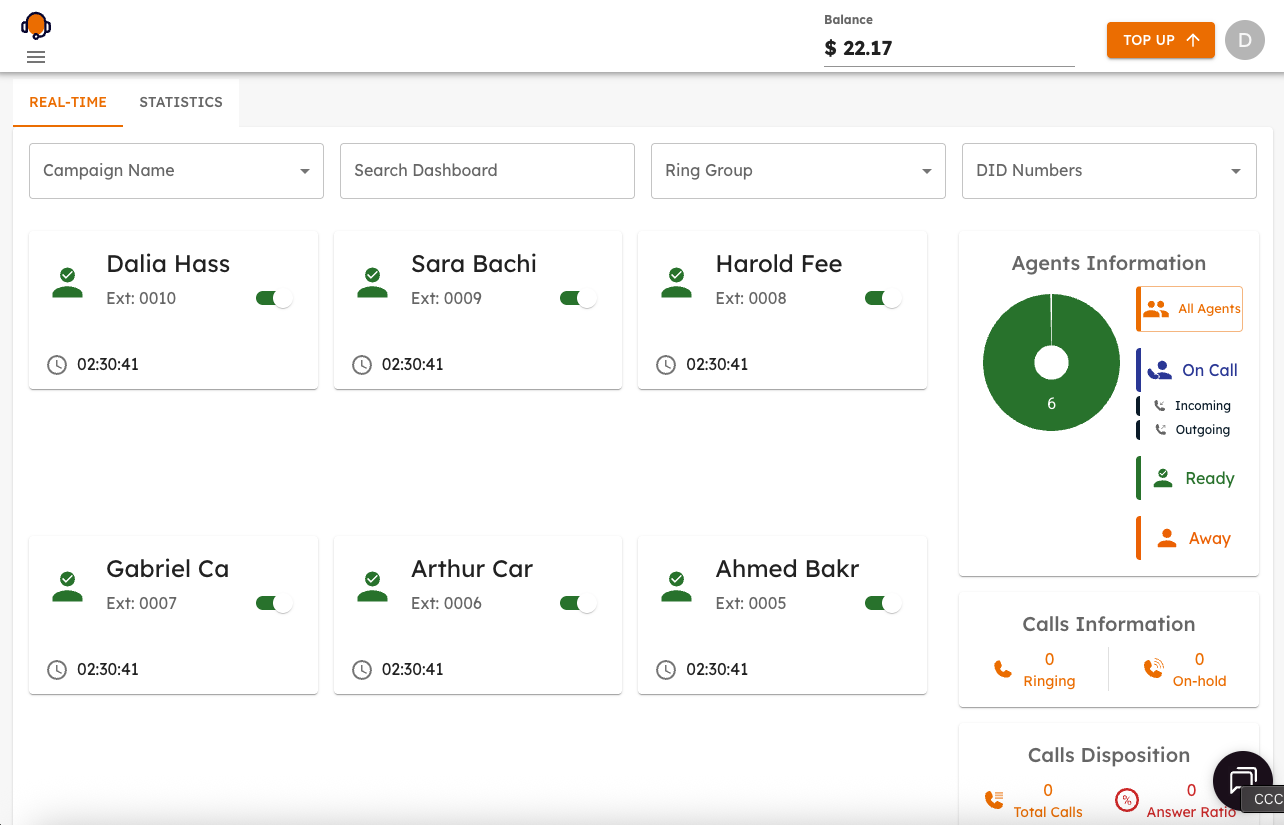
MessageWhiz is an AI-powered call center platform built on operator-grade telecom infrastructure, designed for organizations that need both intelligent automation and uncompromising voice performance. Unlike many AI call center software providers that rely on third-party carriers, MessageWhiz operates as a telecom transit operator, controlling call routing end-to-end. This foundation allows AI capabilities to act on real delivery data rather than abstractions, resulting in higher call completion rates, better audio quality, and more predictable global performance.
AI is embedded across routing, monitoring, and optimization layers to improve outcomes in real time. MessageWhiz applies AI to inbound and outbound call handling and sentiment detection. This enables contact centers to move beyond scripted automation and static rules, using AI to adapt conversations, prioritize critical interactions, and intervene when customer experience is at risk.
Key AI-driven capabilities include:
- AI-optimized call routing with carrier-level control: AI continuously evaluates destination performance, congestion patterns, and historical outcomes to optimize routing decisions, while MessageWhiz maintains full control over the underlying telecom paths
- Real-time sentiment analysis during live calls: AI analyzes voice signals and conversational patterns to detect frustration, confusion, or satisfaction as conversations unfold, enabling proactive escalation or supervisor intervention
- Sentiment-informed prioritization and escalation: Calls with negative or deteriorating sentiment can be flagged automatically, routed to senior agents, or escalated before issues escalate into churn
- AI-enhanced inbound and outbound operations: Improve queue management, prioritize high-value or urgent calls, and optimize outbound dialing efficiency using adaptive, AI-driven logic rather than static campaign rules
- Real-time analytics and AI-driven insights: Monitor call quality, delivery success, agent performance, and sentiment trends through live dashboards, with AI surfacing anomalies and performance risks automatically
- CRM-integrated agent intelligence: Surface customer data, interaction history, sentiment indicators, and next-best-action recommendations directly within agent workflows to reduce handle time and improve first-contact resolution
- Global scalability with local performance intelligence: Combine carrier-grade global infrastructure with AI-driven performance tuning to maintain consistent call quality across regions and high-volume environments
Why MessageWhiz stands out among AI call center software
While many platforms focus on AI-driven experiences at the application layer, MessageWhiz applies AI where it has the greatest operational impact: routing, delivery, and real-time interaction quality. By pairing AI intelligence with direct control over telecom infrastructure, MessageWhiz delivers measurable improvements in call quality, customer experience, and operational reliability that reseller-based AI call center platforms cannot match.
2. Genesys Cloud CX

Genesys Cloud CX is AI-powered contact center software that provides voice, digital, AI, journey analytics, customer engagement, and workforce management capabilities in a single cloud platform with open APIs and integrations.
Key features include:
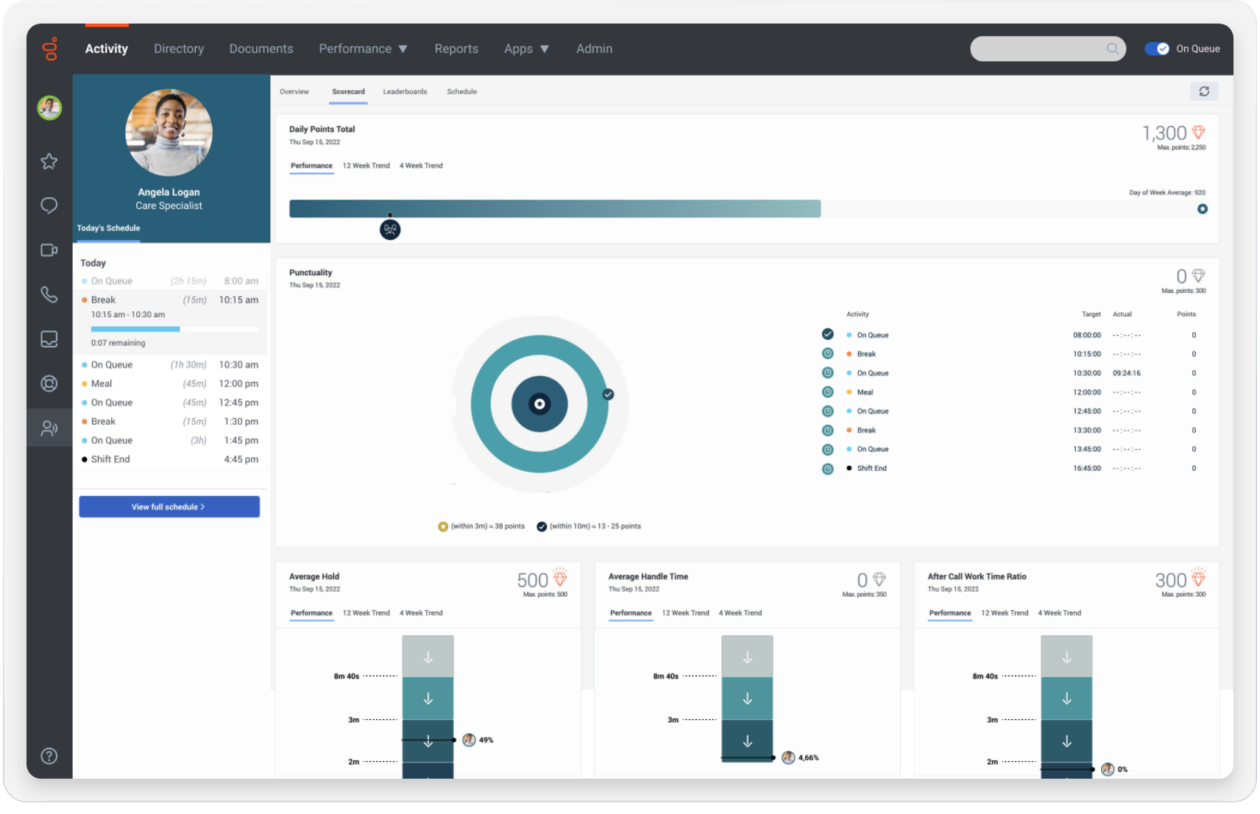
- Omnichannel platform: Provides voice, digital, AI, journey analytics, customer engagement, and workforce management in one cloud platform with open APIs and prebuilt integrations to unify operations.
- Intelligent routing and ACD: Routes interactions using skills-based and predictive routing to connect customers with suitable agents across channels, improving match quality by applying the right criteria at the right time.
- AI assistants and automation: Supports agents with an AI copilot that surfaces information and automates repetitive tasks; deploy virtual agents for self-service; orchestrate work automation to route tasks and manage workflows intelligently.
- Analytics, speech and text analysis: Uses analytics and reporting with speech and text analytics to evaluate every interaction, generate insights, verify compliance, and inform targeted coaching across channels, enabling more consistent quality management.
- Digital engagement tools: Provides live chat, SMS, email, co-browse, and social capabilities within the same platform, preserving context and conversation history for smoother transitions between self-service and assisted support.
3. Uniphore

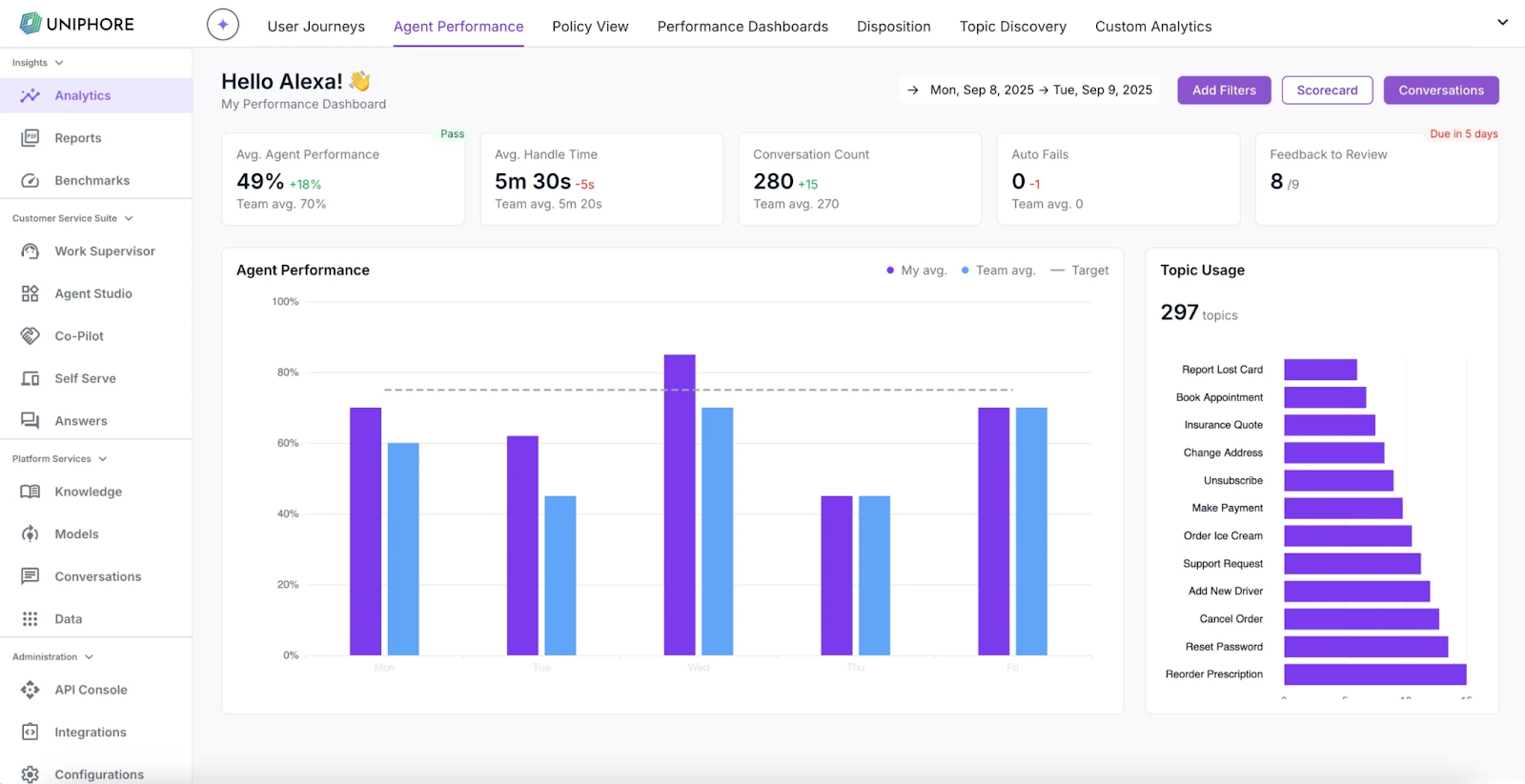
Uniphore Conversation Insights Agent analyzes customer interactions to surface insights with natural-language queries. It is part of the Uniphore Customer Service AI portfolio within the Uniphore Business AI Cloud.
Key features include:
- Natural-language insights: Answers plain-language questions about calls without keywords or technical query building, acting like an analyst that understands context to deliver instant, relevant insights for teams.
- Automated quality monitoring: Scores calls automatically, highlights coaching needs and compliance gaps, and links scores to evidence, replacing manual sampling with consistent, always-on evaluation.
- Topic discovery and drilldown: Detects emerging call drivers beyond predefined tags, then lets users explore sentiment, agent tone, and intent with LLM summaries to understand what happened and why.
- Custom dashboards: Provides configurable dashboards tailored to roles, consolidating metrics like sentiment, agent performance, and call drivers so each team views what matters most to their responsibilities.
- Conversation facts: Surfaces key facts from interactions on demand, enabling quick retrieval of details without complex filtering, and reducing time spent searching across recordings and transcripts.
4. Yellow.ai

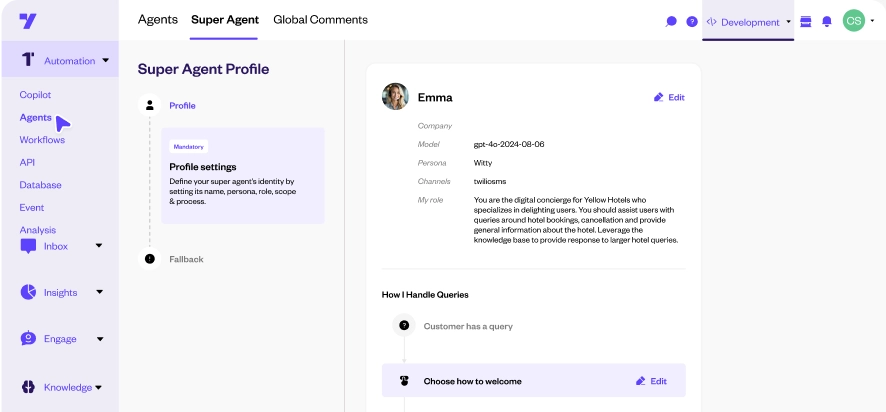
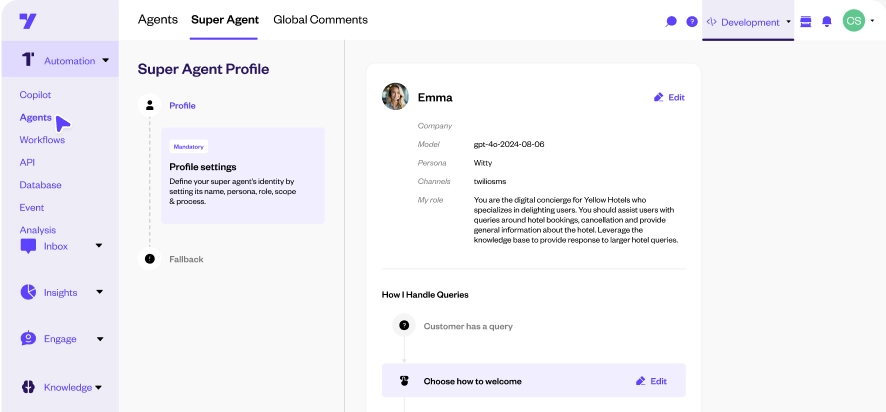
Yellow.ai provides a customer service automation platform across voice, chat, and email. It offers agent assist, AI analytics, a copilot, automated testing, and tools for building and deploying AI agents with minimal setup.
Key features include:
- Agent assist: Supports agents with generative AI tools like auto-response, ticket summarization, and coaching insights, using customer data to personalize assistance during chat, email, and voice interactions.
- Zero setup deployment: Enables faster bot creation and deployment without training or coding, integrating with knowledge bases, CRMs, and other systems to speed time to value and reduce implementation overhead.
- AI copilot: Provides tools to preview, debug, and optimize AI agent performance quickly, helping teams iterate conversation flows and quality before production rollouts across supported channels.
- Analytics and KPIs: Tracks actionable metrics like deflection rate, goal completion rate, customer satisfaction, and first response time, supporting data-driven decisions from real-time operational dashboards.
- Multichannel automation: Covers voice and calls, text and chat, and email automation, allowing organizations to deploy AI across preferred customer channels with consistent orchestration and monitoring.
Source: Yellow.ai
5. Afiniti eXperienceAI

Afiniti eXperienceAI is an AI optimization solution focused on improving contact center routing and performance. It uses existing ACD interaction data and models aligned to chosen metrics for measurable operational impact.
Key features include:
- AI-driven pairing optimization: Optimizes customer-agent pairings based on selected metrics such as average handle time and first call resolution, aligning routing decisions with defined operational objectives.
- Model selection and control: Provides a suite of AI models tailored to measurement goals, enabling administrators to choose and adjust models that best target desired contact center performance improvements.
- Reporting dashboards: Offers dashboards to visualize AI impact and support data-driven decisions, giving transparency into trends, changes, and realized outcomes from optimization strategies.
- Rapid deployment: Delivers cloud-based installation designed for quick rollout, integrating with major telephony systems to start optimizing routing without extensive infrastructure changes or complexity.
6. CloudTalk

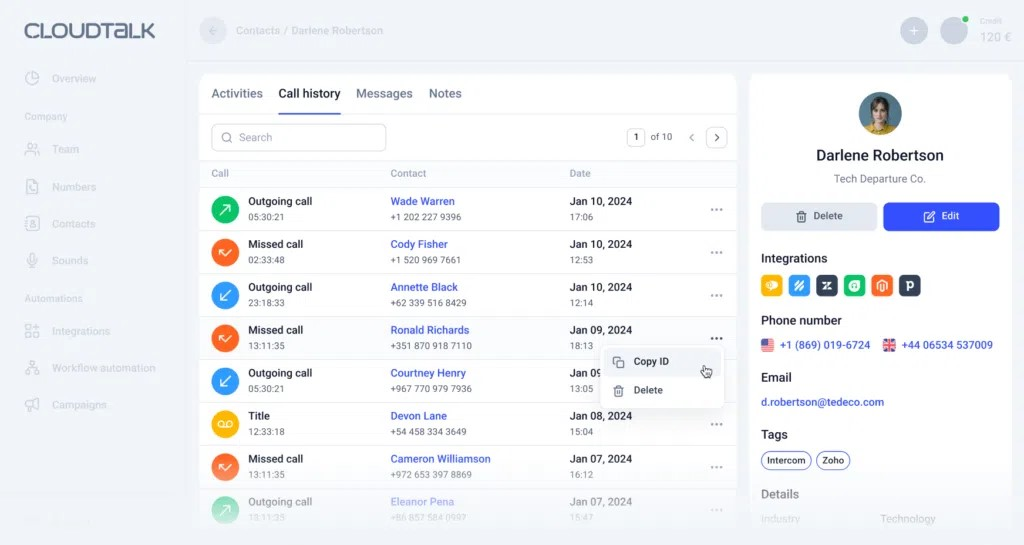
CloudTalk is a cloud phone and contact center platform featuring AI conversation intelligence, outbound dialers, messaging, workflow automation, analytics, and compliance badges, accessible through a web interface and integrations.
Key features include:
- AI conversation intelligence: Auto-analyzes calls with summaries, transcripts, sentiment, key topics, notes, and talk ratios so managers can review more calls efficiently and direct targeted coaching actions.
- AI dialer and outreach: Consolidates call modes including preview and parallel dialing, supports click-to-call, voicemail drop, and answering machine detection to streamline outbound engagement programs.
- Workflow automation: Builds custom call routes and automations to manage interactions, ensuring appropriate flows, escalations, and follow-ups based on configured business rules and conditions.
- Messaging channels: Supports international SMS and WhatsApp messaging for inbound and outbound use cases, enabling agents to communicate through popular text channels alongside voice interactions.
- Analytics and reporting: Tracks trends and team performance with reporting that surfaces activity insights for supervisors, supporting continuous operational oversight and performance management efforts.
7. Creovai

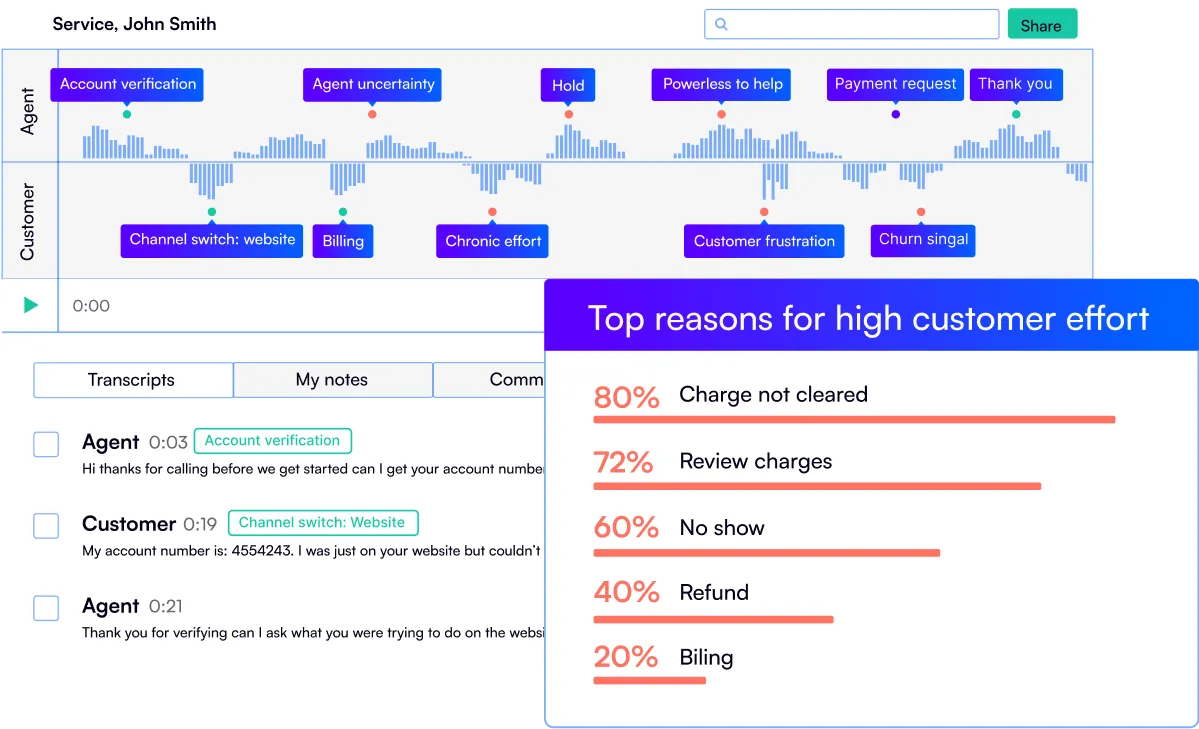
Creovai offers contact center operations capabilities for real-time agent assist, conversation intelligence, QA automation, and advanced analytics that analyze voice and digital interactions to uncover root causes and improvement opportunities.
Key features include:
- Real-time agent assist: Supplies dynamic checklists, prompts, and automated summaries during live calls to reduce average handling time, improve first-call resolution, and guide consistent agent workflows.
- Conversation intelligence: Analyzes interactions across channels to explain why customers switch channels, make repeat contacts, or experience dissatisfaction, informing process improvements that reduce effort.
- QA automation and coaching: Automates scorecards and centralizes coaching sessions to give managers a complete view of performance, helping agents work toward data-backed goals across interactions.
- Advanced analytics: Identifies root causes behind issues like long handle times and repeat contacts, prioritizing changes with the highest impact on customer satisfaction and operating costs.
- Insights at scale: Processes all voice and digital interactions to surface patterns, topics, and trends, enabling teams to act on evidence rather than limited samples or anecdotal feedback.
8. Voiso AI

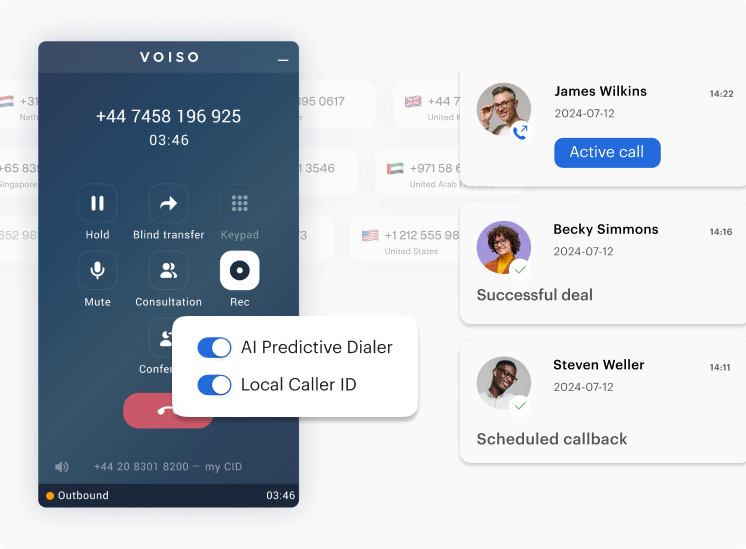
Voiso provides AI contact center tools spanning omnichannel, predictive dialing, flow building, speech analytics, and real-time dashboards. It focuses on managing customer interactions and agent productivity across multiple channels.
Key features include:
- Omnichannel support: Manages interactions across multiple channels simultaneously, helping agents handle conversations more efficiently and accelerating response times while maintaining a unified customer view.
- AI predictive dialer: Automates outbound dialing with prediction and pacing, connecting agents to live answers to maximize talk time and reduce idle periods during campaigns and follow-ups.
- Flow builder: Designs and manages call flows visually to route, prompt, and handle interactions according to business logic, improving consistency and control over customer journeys.
- AI speech analytics: Analyzes calls for topics, keywords, and sentiment, equipping supervisors with insights into conversation quality, customer issues, and compliance risks across recorded interactions.
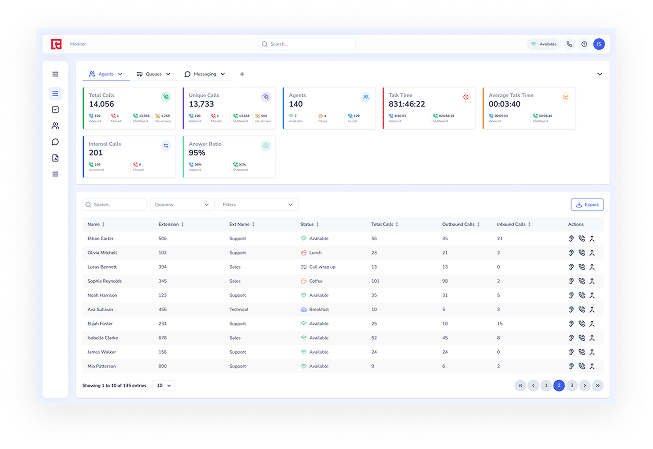
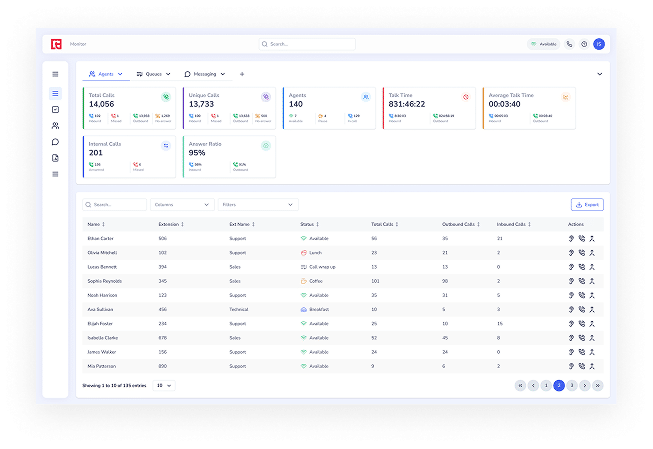
- Real-time dashboards: Displays live operational metrics for queues, agents, and performance, enabling monitoring and adjustments during active shifts to maintain service levels and responsiveness.
9. Nextiva

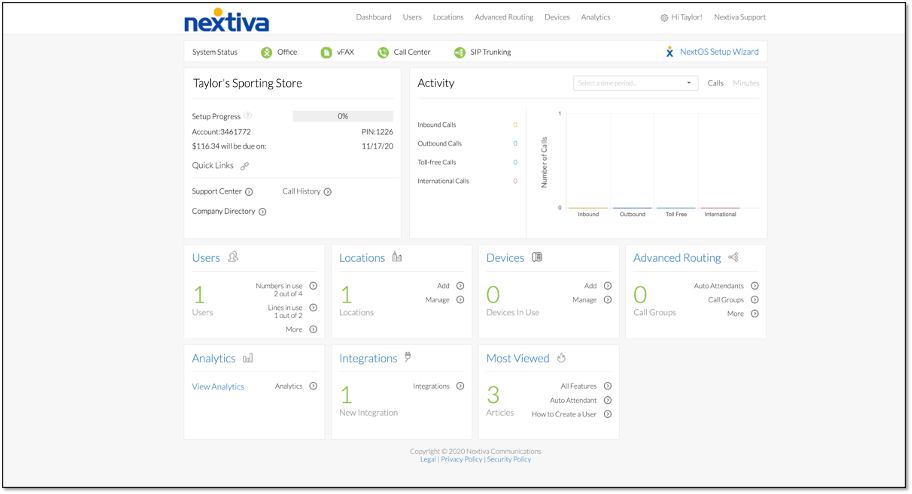
Nextiva offers contact center capabilities with omnichannel engagement, transcription and summarization, automatic call distribution, call analytics, thresholds, inbound calling, and real-time reporting across voice, chat, SMS, email, and social.
Key features include:
- Omnichannel engagement: Connects with customers across voice, chat, SMS, email, social, messaging, and webforms in an integrated experience, preserving context for seamless movement between channels as needed.
- Transcription and summarization: Transcribes interactions and generates summaries to streamline after-call work, enabling faster documentation and easier retrieval of key discussion points for agents and supervisors.
- Automatic call distribution: Routes incoming calls to appropriate agents based on configured rules and preferences, organizing queues efficiently to handle higher call volumes without extended waiting times.
- Call analytics: Surfaces metrics like talk time, abandoned calls, call volumes, and agent availability, with scheduled reports and visual dashboards to assess performance and inform operational decisions.
- Threshold alerts: Notifies teams when queues or estimated wait times exceed set limits, using visual indicators to help supervisors respond to spikes and keep service levels within targets.
10. Squaretalk

Squaretalk provides a contact center platform with voice features, IVR scheduling, queue callbacks, transfers, and messaging options like WhatsApp. It includes dialers, AI voice agents, softphone, spam checking, virtual numbers, and SIP trunking.
Key features include:
- Contact center voice: Supports call management with IVR for after-hours and holidays, queue callbacks, and call transfers to manage higher volumes and speed issue resolution during peak demand periods.
- Predictive dialing: Offers dialing modes to automate outbound outreach, coordinating agent connections and pacing to improve campaign efficiency and reduce manual dialing burdens on teams.
- AI voice agents: Provides configurable voice agents to handle scripted tasks and routine interactions, enabling autonomous responses for defined use cases and integration with telephony workflows.
- WhatsApp messaging: Includes WhatsApp messaging capabilities, enabling communication over a widely used channel for notifications, outreach, and service conversations alongside voice interactions.
- Softphone application: Delivers a softphone for desktop calling with telephony controls and integration points, consolidating agent tooling for handling inbound and outbound calls within a single interface.
Source: Squaretalk
Conclusion
AI call center software is transforming the way customer service teams operate by introducing intelligent automation, real-time assistance, and data-driven insights into every stage of the customer journey. From improving response times and reducing call handling costs to ensuring compliance and enhancing agent performance, these platforms offer scalable solutions that adapt to evolving business and customer needs. As the capabilities of AI continue to mature, organizations that invest in these tools will be better positioned to deliver consistent, efficient, and personalized support at scale.