










What is Omnichannel Marketing?
Omnichannel marketing is a customer-centric strategy that integrates all online and offline channels, such as social media, websites, apps, and physical stores, to create a seamless, consistent brand experience. By synchronizing these touchpoints, businesses improve customer loyalty and drive higher sales by meeting customers where they are with personalized, relevant messaging throughout the purchasing journey.
In omnichannel marketing, brands leverage customer data from various sources to deliver personalized experiences, maintaining context and continuity as customers move between platforms. For example, a customer might browse products on a mobile app, receive personalized recommendations via email, and complete a purchase in a physical store, while their preferences and history are recognized and utilized at each stage.
Key aspects of omnichannel marketing include:
- Data integration and customer profiles: Data from all channels, web, mobile, email, CRM, and in-store systems, is collected and unified.
- Centralized decision layer: A central system processes customer data and determines what message or action should happen next.
- Channel orchestration: Messages and experiences are coordinated across channels.
- Real-time triggers and automation: Customer actions, such as clicks, purchases, or app activity, can trigger immediate responses.
Challenges of implementing omnichannel include:
- Data integration: Siloed data across different channels can make it difficult to create a unified view.
- Technical complexity: Requires robust, integrated technology platforms to work efficiently.
- Consistency across channels: Ensuring consistent messaging, inventory, and experience across both digital and physical channels can be difficult.
This is part of a series of articles about business messaging
How Omnichannel Impacts Marketing and Sales
A well-executed omnichannel strategy improves customer experience and business performance. By connecting channels and data, brands can respond to customer behavior in real time and reduce friction across the journey.
- Consistent customer experience: Customers see the same messaging, offers, and brand tone across all channels.
- Improved personalization: Unified data allows brands to tailor content and recommendations based on behavior, preferences, and history.
- Higher customer retention: Seamless interactions make it easier for customers to continue engaging with the brand.
- Increased conversion rates: Customers can switch channels without losing context, which reduces drop-offs.
- Better data utilization: Data from different touchpoints is combined into a single view.
- Stronger customer insights: Tracking behavior across channels reveals patterns that are not visible in isolated systems.
- Operational efficiency: Integrated systems reduce duplication of effort and improve coordination between marketing, sales, and support teams.
- Scalability across channels: New channels can be added without breaking the customer experience, as they plug into an existing unified system.
How Omnichannel Marketing Works
Omnichannel marketing works by connecting systems, data, and channels into a coordinated framework. The goal is to maintain context as customers move between touchpoints, so every interaction reflects their current state and past behavior.
- Data integration and customer profiles: Data from all channels, web, mobile, email, CRM, and in-store systems, is collected and unified. This creates a single customer profile that includes behavior, preferences, and transaction history. Identity resolution methods, such as login data or device matching, link interactions to the same user.
- Centralized decision layer: A central system processes customer data and determines what message or action should happen next. This layer applies rules, segmentation, and sometimes machine learning to decide which content, offer, or channel is most relevant at a given moment.
- Channel orchestration: Messages and experiences are coordinated across channels. For example, if a customer abandons a cart on a website, the system may trigger an email reminder, followed by a push notification if the email is not opened.
- Real-time triggers and automation: Customer actions, such as clicks, purchases, or app activity, can trigger immediate responses. Automation ensures timely communication without manual intervention.
- Consistent content and messaging: Content is managed so that branding, tone, and offers remain consistent. Templates and shared assets help ensure that updates in one channel are reflected across others.
- Measurement and feedback loops: Performance is tracked across all channels, not in isolation. Metrics such as engagement, conversion, and retention are analyzed together.
Omnichannel Marketing Use Cases and Examples
Customer Acquisition
Omnichannel marketing significantly boosts customer acquisition by coordinating various touchpoints to reach potential buyers where they are. By seamlessly integrating digital campaigns with physical interactions, brands ensure that every exposure reinforces the core message, increasing engagement and the likelihood of prospects entering the sales funnel.
Examples:
- A furniture retailer runs a geographically targeted social media ad. A prospect clicks the ad, which takes them to a page where they can sign up for a design consultation, triggering a welcome email series and an SMS reminder for their scheduled in-person appointment.
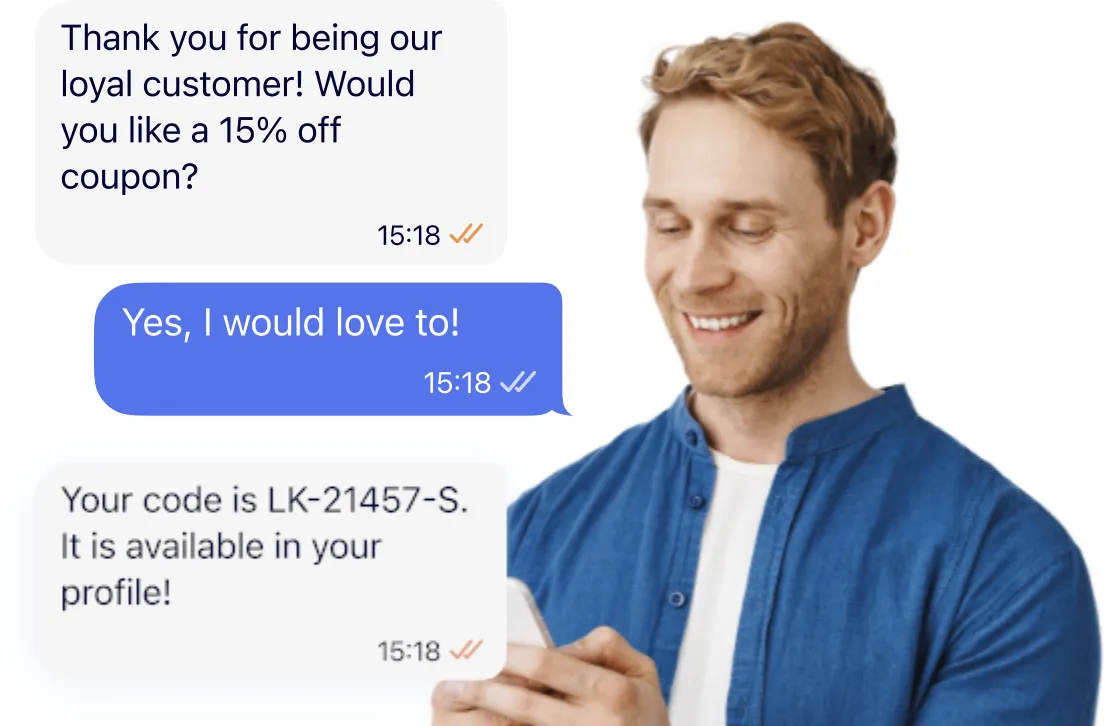
- A sports team uses in-stadium Wi-Fi to serve targeted ads for merchandise discounts on the team’s mobile app. If the fan doesn’t buy at the game, they receive a follow-up email 24 hours later with a special 15% online coupon.
Lead Nurturing
An effective omnichannel strategy ensures leads receive relevant, personalized content tailored to their behavior and position in the sales cycle. This coordinated approach prevents message overlap or conflict, using channels like email, social retargeting, and SMS to continuously build trust and keep the prospect engaged from the initial interest phase through to the final decision.
Examples:
- After a B2B prospect downloads a whitepaper on cloud security, they receive a series of three educational emails. Simultaneously, they are added to a LinkedIn retargeting campaign featuring customer success stories related to the whitepaper topic.
- A financial service lead attends a webinar but doesn’t book a consultation. The next day, they get a personalized SMS summarizing key benefits and a follow-up email from a specific account manager offering to answer questions.
Conversion Optimization
Conversion optimization is a core benefit of omnichannel marketing, focusing on eliminating barriers and providing timely motivation for customers to complete a purchase. By monitoring real-time behavior, brands can deploy automated, channel-appropriate incentives, such as discounts or reminders, to prompt immediate action and ensure a seamless path from browsing to checkout.
Examples:
- A customer adds a pair of running shoes to their cart on a desktop browser but doesn’t check out. Ten minutes later, they receive a WhatsApp message offering free shipping if they complete the purchase within the next hour.
- A hardware store customer researches a specific power drill online and checks local inventory. They receive an email allowing them to click-to-pay and select “curbside pickup” instantly, minimizing their time spent inside the store.
Online-to-Offline (O2O) Experiences
Online-to-Offline (O2O) experiences integrate digital planning with physical fulfillment, significantly enhancing customer convenience. This strategy allows customers to leverage the ease of online browsing and planning, like checking inventory or scheduling services, before physically entering a location, ensuring a highly efficient and personalized in-store visit.
Examples:
- A beauty product customer uses a brand’s mobile app to check if their favorite cleanser is in stock at the nearest mall location. They click “Hold for Pickup,” and the store associate pulls the item, confirming readiness via SMS within minutes.
- When checking in for an oil change, the service advisor at a car dealership pulls up the customer’s online account, seeing they recently browsed tires. The advisor then offers a personalized tire rotation discount without the customer having to mention their interest. Later on, the customer receives SMS reminders for an annual tire change.
Challenges of Implementing Omnichannel Marketing
Data Integration
Integrating data from multiple sources is a significant challenge in omnichannel marketing. Brands often use separate systems for email, social media, CRM, and point-of-sale, leading to fragmented customer profiles. Synchronizing this data requires middleware, APIs, and data management solutions that unify customer information in real time.
Inconsistent or incomplete data can lead to poor personalization and disjointed experiences. Ensuring data accuracy and privacy compliance adds complexity, as brands must manage permissions, consent, and security across platforms.
Technical Complexity
Implementing omnichannel marketing involves technical complexity due to the need for integrated systems and platforms. Brands must connect CRM, marketing automation, analytics, and ecommerce tools so they work together. This often requires custom development, third-party integrations, and ongoing maintenance.
Managing technical complexity also involves adapting to new technologies and evolving customer expectations. As channels expand, such as chatbots, voice assistants, and IoT devices, businesses must update their infrastructure and prioritize investments.
Consistency Across Channels
Maintaining consistency across channels is challenging because each platform has unique formats, user behaviors, and technical constraints. Marketers must adapt messaging and design while preserving brand voice and experience. Inconsistencies can confuse customers and weaken brand trust.
To address this, brands need centralized content management and clear brand guidelines. Regular audits and cross-channel testing help ensure campaigns are coherent.
How to Build an Omnichannel Marketing Strategy
1. Define Goals and KPIs
An omnichannel strategy starts with clear definitions of what the business is trying to achieve and how success will be measured. Goals should reflect outcomes such as retention, conversion efficiency, or revenue per customer, while KPIs translate those outcomes into measurable signals. These metrics must be consistent across channels so performance can be evaluated as a single system rather than isolated campaigns.
Aligning goals with KPIs ensures that channel activity, messaging, and budget allocation are all tied to the same targets. Regular measurement exposes gaps between expected and actual performance, allowing teams to adjust execution and refine assumptions over time.
Key actions:
- Define business outcomes such as retention, conversion rate, or average order value
- Select measurable KPIs such as CTR, CLV, or NPS
- Align KPIs across all channels and teams
- Set reporting intervals and benchmarks
- Use KPI tracking to guide optimization decisions
2. Understand Your Audience
An omnichannel approach depends on a detailed understanding of customer behavior across different touchpoints. This requires combining demographic data, behavioral signals, and transaction history into unified profiles. Data sources typically include analytics platforms, CRM systems, surveys, and social listening tools.
These insights determine how customers move between channels, what content they respond to, and which interactions lead to conversion. A structured view of the audience supports segmentation, targeting, and personalization without relying on assumptions.
Key actions:
- Collect data from analytics, CRM, surveys, and social channels
- Build unified customer profiles combining behavior and attributes
- Segment audiences based on behavior, intent, and lifecycle stage
- Identify preferred channels and interaction patterns
- Use insights to guide messaging and channel selection
3. Map the Customer Journey
Customer journey mapping identifies how users interact with a brand from initial awareness through post-purchase engagement. It requires listing all touchpoints, including digital and offline interactions, and understanding how users move between them. This process highlights friction points, drop-offs, and opportunities to intervene.
A complete journey map supports coordinated campaign design across stages such as awareness, consideration, decision, and retention. It also enables tracking of cross-channel paths rather than single-channel attribution.
Key actions:
- Identify all customer touchpoints across channels
- Map paths from first interaction to conversion and retention
- Detect friction points and drop-off stages
- Define content and actions for each stage
- Use journey data to improve cross-channel coordination
4. Choose the Right Channels
Channel selection should be based on observed customer behavior rather than coverage of all available platforms. Each channel serves a different role, such as acquisition, engagement, or conversion, and should be evaluated based on its contribution to defined KPIs.
Focusing on relevant channels reduces fragmentation and simplifies coordination. Performance data should be used to continuously adjust the mix, removing underperforming channels and scaling those that contribute to outcomes.
Key actions:
- Identify channels where target audiences are active
- Assign roles to each channel (acquisition, nurturing, conversion)
- Prioritize channels aligned with business goals
- Monitor engagement and conversion metrics per channel
- Reallocate budget based on performance data
5. Integrate Data and Tools
Omnichannel execution requires systems to share data in real time. This involves connecting CRM, marketing automation, analytics, and commerce platforms to maintain a single, updated customer profile. Without integration, each channel operates on incomplete or outdated information.
Technical implementation often includes APIs, middleware, and data pipelines that synchronize events and attributes. Data quality processes such as deduplication and validation are required to maintain accuracy and consistency.
Key actions:
- Connect CRM, analytics, and marketing platforms
- Build a unified customer data layer
- Use APIs or middleware for system integration
- Ensure real-time or near real-time data synchronization
- Implement data cleansing and validation processes
6. Create Consistent Content Across Channels
Content consistency ensures that messaging, offers, and brand identity remain aligned across all touchpoints. While formats vary by channel, the underlying message and positioning should remain stable. This prevents conflicting signals and reduces confusion during the customer journey.
Centralized content management enables teams to reuse assets, control versions, and apply updates across channels. Governance processes are required to enforce standards and maintain alignment between teams.
Key actions:
- Define core messaging and brand guidelines
- Adapt content formats without changing meaning
- Use centralized content management systems
- Maintain version control for assets
- Conduct periodic audits for consistency
7. Implement Personalization
Personalization uses unified customer data to adjust content, offers, and interactions based on user behavior and context. This includes rule-based segmentation as well as predictive models that estimate intent or likelihood to convert. Execution depends on real-time access to data and decision systems that trigger actions.
Personalization must also account for privacy constraints. Consent management and data governance policies are required to control how data is collected and used across channels.
Key actions:
- Use behavioral and transactional data for segmentation
- Deliver dynamic content and recommendations
- Implement real-time decisioning systems
- Apply machine learning models where relevant
- Manage consent and enforce data privacy policies
8. Test, Measure, and Optimize
Omnichannel strategies require continuous testing to identify which combinations of channels, messages, and timing produce results. Experiments such as A/B testing should be applied across channels, not only within them. Measurement must reflect full customer journeys rather than isolated interactions.
Optimization relies on combining data from multiple sources to evaluate performance. Insights should feed back into segmentation, channel allocation, and content updates to improve outcomes over time :contentReference[oaicite:0]{index=0}.
Key actions:
- Run A/B tests across channels and touchpoints
- Track cross-channel journeys and attribution
- Measure metrics such as conversion, retention, and CLV
- Analyze results to identify performance drivers
- Update strategy based on data-driven insights
Omnichannel Messaging with MessageWhiz
Executing an omnichannel strategy depends on more than a central data layer and a good plan. The channels you use to reach customers determine whether the strategy works in practice. A trigger that fires at the right moment loses its value if the message arrives late, lands on the wrong channel, or never gets delivered at all.
MMDSmart’s MessageWhiz handles the delivery side of omnichannel marketing across SMS, WhatsApp, RCS, Viber, Telegram, email, and voice from a single platform. Your CRM, AI agents, or other management systems hold the customer data and determine what should happen next. MessageWhiz executes the response, on the right channel, at the right time, with the delivery rates to back it up.
That single-platform approach matters for omnichannel specifically. When all channels run through one system, context is preserved, reporting is unified, and the experience your customer receives stays consistent whether they are reading an SMS, opening a WhatsApp message, or responding to an email.
Real-time API integration means MessageWhiz connects directly into your existing stack rather than sitting alongside it. Triggers from your CRM or data platform fire instantly, two-way conversations are managed across all channels from one interface, and AI-driven routing ensures each message takes the most reliable path to delivery.
Explore the MessageWhiz platform to see how it supports omnichannel marketing in practice.